Zestimate Accuracy: How Close Is It to What Your Home Will Actually Sell For?
-
 Research Team
 - 07 Aug, 2026
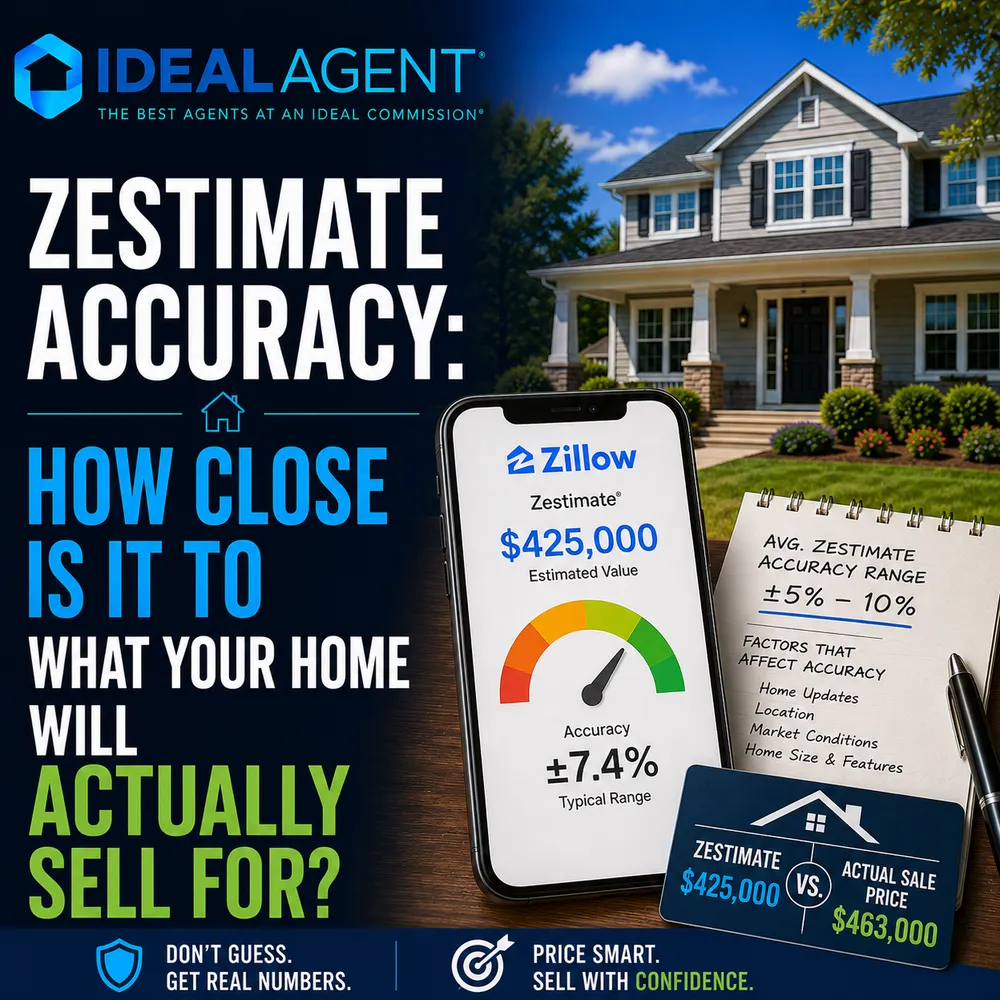
Checking your Zestimate is often the first thing sellers do before they’ve even decided to sell — and it’s also one of the most misunderstood numbers in real estate, treated as a fact when it’s actually a statistical estimate with real, documented margins of error.
Short answer: A Zestimate is an automated home value estimate based on public records, tax assessments, and recent comparable sales, not a formal appraisal. Zillow itself reports a median error rate that varies by market and by whether a home is currently listed — often within a few percentage points for on-market homes, but wider for off-market homes and less predictable in areas with limited recent sales data. It should be treated as a starting point, not a listing price.
What Is a Zestimate, Exactly?
A Zestimate is Zillow’s automated valuation model (AVM) — a computer-generated estimate of a home’s market value, built from public property records, tax assessment data, user-submitted home facts, and recent sales of comparable homes in the area. It updates automatically as new data becomes available, without a human appraiser or agent ever setting foot in the property.
This automation is exactly what makes it useful for a quick, free reference point — and exactly what limits its accuracy for anything more precise than that.
How Accurate Is a Zestimate, According to Zillow’s Own Data?
Zillow publishes its own median error rate, which represents how far off the estimate typically is from the eventual sale price. This rate is generally tighter for homes currently listed for sale (since more current, relevant data is available) and wider for homes not on the market. Error rates also vary meaningfully by location — denser markets with lots of recent comparable sales tend to have tighter accuracy than rural areas or markets with few recent transactions.
Because these published rates are medians, roughly half of all homes will have an error larger than the reported median — meaning a meaningful share of Zestimates are off by more than the headline number suggests, in either direction.
Why Can a Zestimate Be Significantly Wrong for a Specific Home?
An automated model can’t see inside your house. It doesn’t know about a fully renovated kitchen, a finished basement that isn’t reflected in public records, deferred maintenance that would concern a buyer, or a layout quirk that affects how the home shows in person. It also can’t account for hyper-local factors like a busy street, an unusually good or bad lot, or a school boundary line that splits two otherwise similar blocks into very different price tiers.
Homes with unique features, non-standard layouts, or in markets with few recent comparable sales tend to see the largest gaps between the automated estimate and actual market value.
How Does a Zestimate Differ From a Comparative Market Analysis?
| Zestimate | Comparative Market Analysis (CMA) | |
|---|---|---|
| Who prepares it | Automated algorithm | A real estate agent, based on local expertise |
| Data used | Public records, tax data, recent sales | Recent comparable sales, current market conditions, in-person knowledge of the home |
| Sees inside the home | No | Often yes, or informed by detailed photos/description |
| Accounts for current buyer demand | Limited | Yes, based on active market conditions |
| Best used for | A rough, free starting reference | Setting an actual listing price |
A CMA incorporates judgment a pure algorithm can’t — recognizing that a renovated kitchen actually shows well, or that a particular comparable sale isn’t a fair match because of a condition difference the public records don’t capture.
Does a Zestimate Reflect Current Market Conditions?
Not always in real time. Zestimates update based on available data, but in fast-moving markets — where prices are rising or falling quickly — the underlying comparable sales data can lag behind what’s actually happening on the ground. An agent actively working in your specific neighborhood typically has more current insight into pending sales, buyer demand, and pricing trends than an algorithm that’s working from already-closed transaction data.
Should You Use a Zestimate to Set Your Listing Price?
No — and this is the single most common mistake sellers make with these tools. Pricing a home too high based on an inflated automated estimate can cause it to sit on the market, which often leads to price reductions that make buyers wonder what’s wrong with the property. Pricing too low based on a conservative estimate leaves money on the table. A proper listing price accounts for your specific home’s condition, recent truly comparable sales, and current local buyer demand — all things a professional pricing analysis captures far better than an automated tool.
Do Automated Estimators Update When You Make Improvements?
Sometimes, but not reliably or immediately. Public records — the primary data source for these models — often lag significantly behind actual renovations, since permits and assessments aren’t always updated promptly, and not every improvement (a remodeled bathroom, new flooring, updated lighting) shows up in public data at all. If you’ve made significant improvements, don’t assume your automated estimate reflects them; a professional pricing analysis from an agent who’s actually seen the work will be far more accurate.
What’s the Right Way to Use a Zestimate?
Treat it as a rough starting point for your own curiosity — a way to get a general sense of your home’s value range before you talk to anyone. It’s a reasonable tool for tracking general trends over time or getting a ballpark figure. It is not a substitute for a professional pricing strategy built around your home’s actual condition, your specific market’s current activity, and comparable sales an agent has personally verified.
IDEAL AGENT matches sellers with a top 1% local agent who builds your actual listing price around real, current market data — not an algorithm working from public records. That agent lists your home for a firm 2% commission, well below the 2.5–3% many sellers pay with a traditional agent, and the recommended buyer’s agent commission is 2%–2.5%. If a buyer comes directly through that agent’s marketing of your home, your total commission is capped at 2% combined for both sides — accurate pricing and strong representation, without the traditional commission cost.
Frequently Asked Questions
Is a Zestimate the same as an appraisal?
No. An appraisal is a professional, in-person valuation typically required by a lender, conducted by a licensed appraiser. A Zestimate is an automated estimate with no human review of the property.
Can I dispute or correct my Zestimate?
Zillow allows homeowners to claim their home and update certain facts (square footage, bedrooms, recent updates), which can improve accuracy, though it doesn’t guarantee the estimate will match your expectations.
Why is my Zestimate different from a neighbor’s similar home?
Even similar homes can have different Zestimates due to differences in lot size, exact comparable sales used, public record data accuracy, or timing of the last data update.
Do Zestimates go up right before you list?
Not automatically — Zestimates update based on data changes and market activity, not based on your intent to sell. Listing your home and generating buyer interest may eventually influence future automated estimates once a sale closes and becomes part of the comparable sales data.
Is a Zestimate more or less accurate than other online home value tools?
Accuracy varies by tool and by market — no single automated valuation model is consistently most accurate everywhere. This is one reason comparing several tools, alongside a professional analysis, gives a more complete picture than relying on any one estimate.
Should I be worried if my Zestimate is lower than what I paid for my home?
Not necessarily — automated estimates can lag behind market appreciation, miss unrecorded improvements, or simply carry a wide error margin for your specific property. A professional comparative market analysis will give you a far more reliable answer than an automated estimate alone.
How often does a Zestimate update?
Zillow updates Zestimates regularly as new data becomes available, though the frequency and the specific data driving any given update aren’t always visible to homeowners.
Your actual listing price should come from real market analysis, not an algorithm’s best guess. Get matched with a top 1% local agent who prices your home accurately and lists for 2% commission.