Why I Don't Trust "Top Agent" Rankings — and What I Check Instead
-
 Steve Johnston
 - 07 Sep, 2026
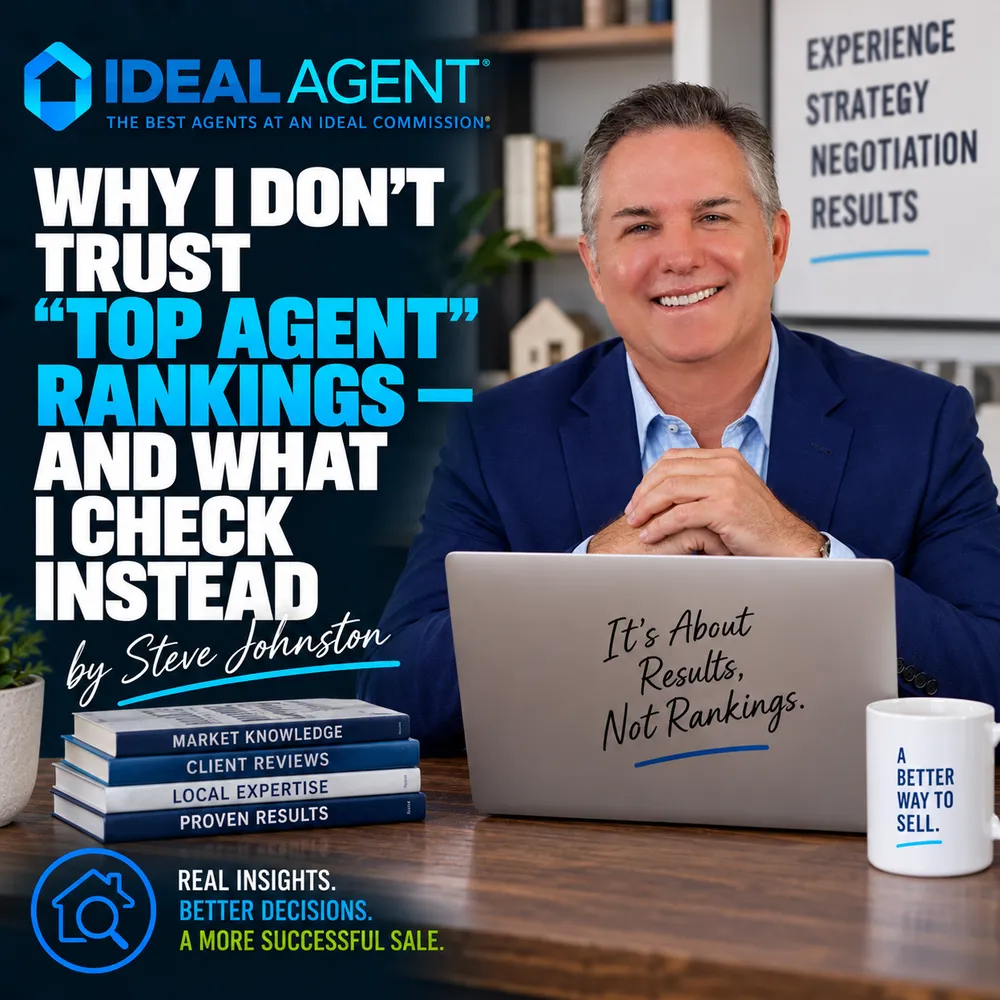
I’ve spent 25 years in this industry, and I can tell you plainly: a “Top Agent” badge on a website or a “5-star, top-rated” label in an ad tells you almost nothing reliable about whether that agent will actually get you the best outcome. I don’t say that to be cynical — I say it because I’ve watched how these rankings actually get built, and sellers deserve to know what’s really behind them before they let a badge make their decision for them.
Short answer: Many “top agent” rankings and badges are based on advertising spend, self-reported sales figures, review volume, or membership fees paid to a ranking platform — not independently verified transaction performance. Before trusting any ranking, check what it’s actually measuring, verify claims against public MLS sales data where possible, and prioritize direct evidence of recent results over a badge or label alone.
Why Am I Skeptical of Most “Top Agent” Labels?
Over the years, I’ve seen how many of these rankings actually get compiled. Some are based on how much an agent pays a specific website or platform for premium placement and a “top agent” designation — essentially an advertising product dressed up as a merit-based ranking. Others rely on self-reported sales volume with no independent verification, meaning an agent’s own claimed numbers go largely unchecked. Still others weight customer review volume heavily, which measures how many people left a review, not necessarily how strong the actual sale outcomes were. None of this means every agent with a badge is dishonest or ineffective — but it does mean the badge itself isn’t reliable evidence of genuine top-tier performance.
What Do Legitimate Rankings Actually Require?
A ranking genuinely worth trusting should be based on independently verifiable transaction data — actual closed sales pulled from MLS or public records, not self-reported figures. It should measure results relevant to what you actually care about: sale-price-to-list-price ratio, average days on market relative to your specific market’s norms, and genuine transaction volume over a recent, defined period — not lifetime career totals that could span decades and say little about an agent’s current activity level. Very few consumer-facing “top agent” websites meet this bar, which is exactly why I encourage sellers to look past the badge and ask for the underlying data directly.
What Should You Actually Ask an Agent to Verify Their Claims?
Ask for their specific number of closed transactions over the past 12 months, not a lifetime total. Ask for their average sale-price-to-list-price ratio on recent sales, which tells you how close they typically get to (or above) asking price. Ask how their average days on market compares to the overall market average in your specific area during the same period. And ask for a few recent, specific addresses you can look up yourself in public records or on a real estate website, to independently verify the figures they’ve given you rather than taking their word for it.
Why Does Recency Matter More Than Career Totals?
An agent who closed a large volume of transactions a decade ago but has slowed down significantly in recent years isn’t necessarily the strongest choice for your sale today. Markets change, agent priorities shift, and what matters most is whether someone is actively, currently performing at a high level — not a resume built on activity from years past. When I evaluate agent performance for matching sellers, recent, verifiable activity carries far more weight than an impressive-sounding career total that might be masking a much slower current pace.
What About Online Reviews — Are They Trustworthy?
Reviews can offer some useful signal, but they’re an incomplete picture on their own. A high review count can reflect genuine client satisfaction, but it can also reflect an agent who’s simply been in business a long time and asks every client for a review, regardless of how strong the actual outcome was. Reviews rarely tell you anything about the specific metrics that actually determine your sale’s success — pricing accuracy, negotiation strength, marketing effectiveness. I’d treat reviews as one input among several, not the deciding factor on their own.
Does a Bigger Brokerage Name Automatically Mean a Better Agent?
Not necessarily. Brokerage brand recognition can matter for certain aspects of a sale, but individual agent performance varies enormously even within the same brokerage. I’ve seen top-performing agents at smaller, independent brokerages consistently outperform average agents at large, well-known national brands, simply because individual skill, work ethic, and current market activity matter more than the name on the sign. Evaluating the specific agent’s own track record matters more than the brokerage’s overall reputation.
How Should You Actually Evaluate an Agent Before Hiring Them?
Request specific, recent, verifiable data rather than relying on badges or marketing claims. Ask direct questions about their current transaction volume and recent results. Look up a few of their recent sales independently if you can. And pay attention to how specifically and confidently they answer these questions — an agent with genuinely strong recent performance should be comfortable providing real numbers, not deflecting into general reputation or vague claims of success.
Why Did I Build IDEAL AGENT Around This Exact Problem?
This is precisely the gap I built IDEAL AGENT to close. Rather than asking sellers to sort through marketing badges and unverified claims themselves, we independently vet agents based on actual, current, verifiable performance data before matching them with sellers — so “top 1%” means something real and checked, not a label someone paid for. That agent lists your home for a firm 2% commission, well below the 2.5–3% many sellers pay with a traditional agent. The recommended buyer’s agent commission is 2%–2.5%, and if a buyer comes directly through that agent’s marketing of your home, your total commission is capped at 2% combined for both sides — genuine top-tier vetting, at a lower cost than the traditional model.
Frequently Asked Questions
Are all “top agent” badges meaningless?
Not entirely meaningless, but many are based on advertising spend or self-reported data rather than independently verified performance, so they shouldn’t be relied on alone without further verification.
How can I independently verify an agent’s claimed sales numbers?
Ask for specific recent addresses and look them up through public records or real estate websites showing sale price and closing date, which lets you confirm the agent’s claims yourself.
Does years of experience matter more than recent performance?
Recent, current performance is generally more relevant to your specific sale than career-long experience alone, since market conditions and an agent’s current activity level can change significantly over time.
Should I ignore online reviews entirely when choosing an agent?
No, but treat them as one input among several rather than the deciding factor — reviews don’t necessarily reflect the specific pricing, negotiation, and marketing metrics that actually determine your sale’s success.
Does a national brokerage brand guarantee a better agent?
No — individual agent performance varies significantly even within the same brokerage, so evaluating the specific agent’s own track record matters more than the brokerage’s general reputation.
What’s the single most important number to check before hiring an agent?
Recent sale-price-to-list-price ratio and recent days on market relative to your local market average are two of the most directly relevant indicators of an agent’s actual current performance.
How does IDEAL AGENT verify agent quality differently than typical rankings?
Rather than relying on self-reported claims or paid placement, IDEAL AGENT vets agents based on independently verifiable, current transaction data before matching them with sellers.
Don’t let a badge make this decision for you — verify the numbers yourself, or let us do it for you. Get matched with a top 1% local agent, independently vetted and listing for 2% commission.