The Truth About Private Listings: How They Hurt Sellers, Limit Buyers, and Set the Real Estate Industry Back
-
 Steve Johnston
 - 01 May, 2026
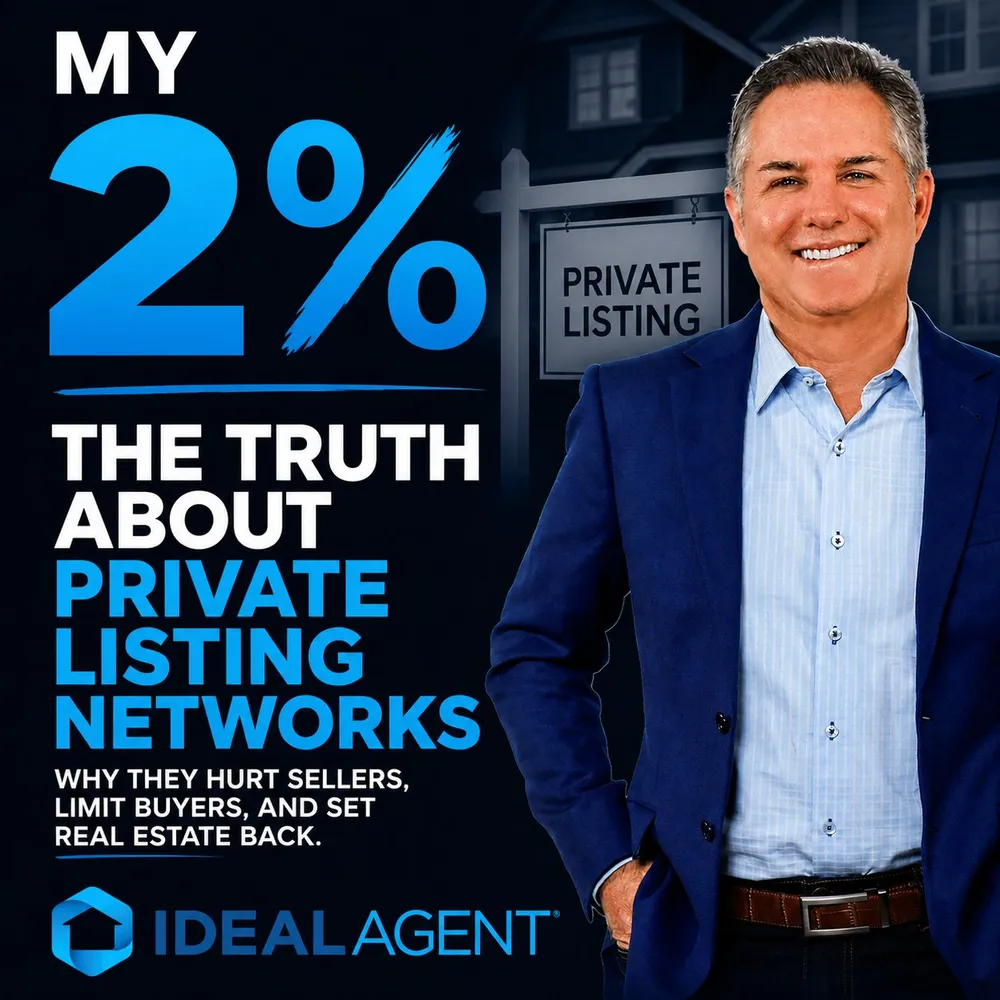
I’ve spent 25 years in residential real estate. I’ve watched the industry evolve through market crashes, commission reform, the rise of online listings, and more regulatory change than most people care to track. And in all that time, the core principle that protects home sellers has never changed: maximum exposure creates maximum competition, and maximum competition produces the highest sale price.
That’s why the current push toward private listings — also called off-market listings or private listing networks (PLNs) — concerns me as much as anything I’ve seen in this industry. It sounds sophisticated. It’s being sold as “exclusive.” But for the typical home seller, it’s a step in exactly the wrong direction. And the data now proves it.
Short answer: Private listings limit the number of buyers who can see your home. Fewer buyers means less competition. Less competition almost always means less money in your pocket at closing — and there’s over $1 billion in seller losses from 2023 and 2024 alone to back that up.
What Is a Private Listing — and Why Is It Growing?
A private listing is a home that is marketed outside of the MLS (Multiple Listing Service) and made available only to a controlled pool of buyers — typically those within a single brokerage or a select private network.
The MLS was built specifically to prevent this kind of fragmentation. It created a centralized, transparent system where all licensed agents — regardless of brokerage — could access all available inventory on behalf of their clients. That open architecture is what makes competitive bidding possible. It’s what ensures a seller anywhere in the country isn’t only being seen by buyers who happen to work with one particular firm.
Private listing networks deliberately route around that system.
So why are they growing? Because they benefit brokerages, not consumers. A brokerage that keeps listings in-house has a much better chance of representing both the buyer and the seller on the same transaction. That’s a significant financial incentive — and as I’ll explain below, it has nothing to do with getting you the best price for your home.
The trend is accelerating in ways sellers should find alarming. A January 2025 survey found that 63% of sellers said their agents encouraged them to list on a private listing network — up from just 18% five years ago. At the same time, 68% of those sellers said their agent never explained the difference between listing on the MLS versus listing on a private network. That’s not a coincidence. That’s a pattern.
Why Private Listings Cost Sellers Money
Exposure Drives Competition — and Competition Drives Price
This is not a theory. It’s how real estate has worked for decades, and the numbers now confirm it at scale.
A Zillow study covering 10 million transactions across 46 states found that sellers who listed off the MLS left more than $1 billion on the table in 2023 and 2024 alone — a typical loss of $4,975 per home, with losses in markets like California reaching as much as $30,000. A separate multi-state study by Bright MLS and Drexel University found that homes listed on the MLS sold for 17.5% more than comparable off-MLS listings, representing more than $53,000 for the typical seller.
When you list a home publicly on the MLS, it becomes visible to every active buyer in your market, every buyer’s agent, and every major real estate platform — Zillow, Realtor.com, and hundreds of others that pull MLS data. You are marketing to the entire buying pool simultaneously.
When you list privately, you are marketing to a fraction of that pool. The math is straightforward: if 200 qualified buyers see your home and three make offers, you have leverage. If 15 buyers see your home and one makes an offer, you take what you can get.
Most Private Listings Fail — and Then Waste Your Time Getting to the MLS
Here’s the part that rarely gets discussed: private listings don’t just cost sellers money. They cost sellers time.
According to Bright MLS chief economist Lisa Sturtevant, nine out of ten listings that start as private listings ultimately end up on the MLS anyway. Let that sink in. The overwhelming majority of sellers who go the private listing route don’t sell privately — they eventually have to bring their home to the open market just like everyone else, except now they’ve burned days or weeks in the process.
And that delay has consequences. A home that sits in a private network without selling can accumulate what the industry calls “market time.” When it finally hits the MLS, buyers notice. They wonder why it didn’t sell privately. They wonder if something is wrong with it. That perception weakens your negotiating position before a single offer is even submitted.
You Lose True Price Discovery
Price discovery is what happens when a home is fully exposed to the market and buyers bid based on genuine demand. It’s how you find out what your home is actually worth to the people who would pay the most for it.
A private sale short-circuits that process. You may receive an offer that feels strong — but you have no way of knowing whether a fully competitive market would have produced something better. The buyer in a private transaction often knows they have an advantage. That’s frequently why they’re pursuing off-market deals in the first place.
The Real Problem with Dual Agency in Private Listings
I want to address dual agency carefully here, because it’s more nuanced than most people realize — and getting it wrong does a disservice to sellers.
Dual agency itself is not inherently evil. There are legitimate scenarios where an agent representing both buyer and seller is fine — and can even benefit both parties. At IDEAL AGENT, for example, if a buyer comes to us directly through a listing’s advertising, our agent will handle both sides of the transaction at 2% total commission. The seller saves. The buyer saves. The agent isn’t collecting a windfall — they’re facilitating a clean, efficient transaction at a reduced cost to everyone involved.
That’s dual agency done right.
The problem is dual agency driven by self-interest. When a brokerage steers a listing into a private network specifically to manufacture a double-ended commission — where the agent collects the full buyer’s side and the full seller’s side — the financial incentive is no longer about closing a great deal. It’s about closing a deal. Any deal. At whatever price makes the buyer say yes.
That agent is not negotiating hard for your top dollar. They can’t be. They’re serving two clients with opposing financial interests, and they have a personal stake in the transaction closing regardless of outcome. The seller’s goal — maximum price — directly conflicts with the buyer’s goal — minimum price — and the agent is caught in the middle, motivated primarily by their own commission.
That is the version of dual agency that private listing networks enable and encourage at scale. And what makes it worse is that most agents recommending PLNs appear to genuinely believe their own pitch. A survey of more than 1,000 agents found that 56% believe private listing networks increase the sale price of a home — directly contradicting all available research. These aren’t bad actors in every case; they’re misinformed professionals repeating talking points from brokerages with a financial stake in keeping listings off the open market.
What Private Listings Mean for Buyers
Sellers aren’t the only ones harmed by this trend. Buyers — particularly first-time buyers who don’t have established relationships with large brokerages — are increasingly shut out of inventory they don’t even know exists.
If a meaningful percentage of homes in a given market are being sold through private networks before they ever hit the MLS, buyers without insider access are competing for a reduced pool of homes. That artificially inflates demand in the public market while the best-positioned buyers quietly transact in the private one.
It creates a two-tiered system: one for buyers with connections, and one for everyone else. Ninety-one percent of buyers in a recent survey said they believe they should be able to see and access all available listings for free. Private listing networks make that impossible by design — and the result raises legitimate fair housing concerns that regulators are already beginning to act on.
States Are Starting to Ban Private Listings — And for Good Reason
Private listings aren’t just a consumer protection concern — they’re increasingly a legal one.
Washington state recently became one of the first in the country to ban private listing networks outright, requiring that homes be submitted to the MLS before any private marketing can occur. Other states are actively moving in the same direction as the harm to sellers becomes harder to ignore. The legislative momentum reflects what consumer advocates and industry watchdogs have been arguing for years: private listing networks harm sellers, restrict buyer access, and undermine the transparency that makes real estate markets function fairly.
The legal landscape is shifting quickly. In some markets, what’s permitted today may be prohibited by the time you’re ready to sell. But even where private listings remain legal, the question sellers should be asking isn’t “can my agent do this?” — it’s “should they?”
It’s also worth knowing that NAR introduced a “delayed marketing exempt listing” option in March 2025, which allows sellers to delay public syndication for a period while the listing remains visible to MLS participants — but not to the general public. The catch: Zillow announced it will not display any listing that uses the delayed marketing exemption, even after the delay period ends. That means sellers who choose delayed marketing could permanently lose access to Zillow’s audience — a substantial share of all online home searches. That’s a significant and often undisclosed tradeoff.
The MLS Exists for a Reason — We Should Protect It
The Multiple Listing Service wasn’t created arbitrarily. It emerged from decades of industry experience with exactly the kind of fragmentation that private listing networks are reintroducing. The MLS made real estate more fair, more transparent, and more efficient. It gave sellers access to the entire buyer pool and gave buyers access to the entire inventory.
Walking that back — even incrementally, even under the banner of “exclusivity” — is a regression. It is not innovation.
I’ve built IDEAL AGENT on the premise that sellers deserve better: better agents, better service, and more transparency — not less. The way to get a great outcome when you sell your home is to work with a top-performing agent who knows how to price, market, and negotiate — and who puts your home in front of every qualified buyer in your market. That’s the opposite of a private listing.
When a Private Sale Might Make Sense
I want to be intellectually honest here: there are narrow circumstances where an off-market transaction makes sense.
- Celebrity or executive sellers who face genuine security or privacy concerns with public listings
- Sellers testing a price point before formally launching — though this should be a brief, structured window, not a default strategy
- Unique or trophy properties where the buyer pool is so small that a targeted private approach is more efficient than mass-market exposure
These are real exceptions. But they apply to a small fraction of sellers — not the average homeowner trying to get the best price for what is likely their largest financial asset. And remember: even in these cases, nine out of ten private listings end up on the MLS anyway.
If your agent is recommending a private listing and you don’t fall into one of those categories, it’s worth asking who this arrangement actually benefits.
What Sellers Should Do Instead
If you’re preparing to sell your home in 2026, here’s what I’d tell you — the same thing I’d tell a family member:
- Insist on full MLS exposure from day one. Don’t let any agent talk you into a “quiet listing” or extended “pre-market period” that keeps your home off the MLS for weeks. The research is unambiguous: MLS-listed homes sell for more.
- Be cautious about delayed marketing options. NAR’s new delayed marketing exemption might sound like a reasonable middle ground, but if it costs you Zillow visibility permanently, you’re giving up a massive share of buyer reach before negotiations even begin.
- Understand who your agent is working for. If a dual-agency situation arises, find out exactly how your agent is being compensated — and whether any reduced service to you is reflected in a reduced commission, or whether they’re simply collecting both sides at full price.
- Work with a proven agent. The agent’s ability to price strategically, market professionally, and negotiate effectively matters far more than whether they’re part of a private network.
- Create competitive pressure. The best outcomes for sellers almost always involve multiple offers. That requires maximum exposure — full stop.
The goal is simple: put your home in front of every qualified buyer in your market and let real competition determine the price.
Frequently Asked Questions
Are private listings legal everywhere?
No — and the legal landscape is changing rapidly. Washington state recently banned private listing networks outright, requiring homes to be submitted to the MLS before any private marketing can occur. Other states are actively considering similar legislation. Even where private listings remain legal, sellers should understand they are trading exposure — and very likely sale price — for an arrangement that primarily benefits the brokerage.
Do private listings sell for less than MLS listings?
Yes, consistently and significantly. A Zillow study of 10 million transactions found that off-MLS sellers lost more than $1 billion in 2023 and 2024, with a typical loss of $4,975 per home. A Bright MLS and Drexel University study found MLS-listed homes sold for 17.5% more than comparable off-MLS properties — representing over $53,000 for the typical seller. Sellers in 44 of the 46 states studied saw losses from selling off-MLS.
If most private listings end up on the MLS anyway, what’s the harm in trying?
The harm is time and perception. Nine out of ten private listings eventually migrate to the MLS — meaning the vast majority of sellers who try the private route don’t complete a sale there. But those sellers haven’t just lost time. A home that sits in a private network without selling can appear stale when it finally hits the MLS. Buyers notice market time. They wonder why it didn’t sell privately. That erodes your leverage and can cost you more than the private listing approach was supposed to save.
Is dual agency always bad for sellers?
Not always — it depends entirely on the incentive structure. When a buyer finds a listing organically and both parties agree to the same agent at a meaningfully reduced commission, everyone can benefit. The problem arises when an agent steers a listing into a private network specifically to engineer a double-ended commission at full price. In that scenario, the agent is motivated to close the deal — not to maximize the seller’s outcome. Always ask what commission the agent earns if they represent both sides, and whether that is reflected in a lower rate to you.
What is a Private Listing Network (PLN)?
A Private Listing Network is a platform or arrangement where brokerages share listings exclusively among themselves before — or instead of — putting them on the MLS. Major brokerages have launched their own PLNs in recent years. The practical effect is the same as any off-market listing: restricted exposure, limited competition, and for most sellers, a lower final sale price. Private listings currently account for roughly 4% of all listings in tracked MLS territories — but the push to grow that share is exactly what consumer advocates and state legislators are now pushing back against.
If you’re thinking about selling, the most important decision you’ll make is who represents you — and whether they’re truly in your corner. Find a top local agent through IDEAL AGENT and get full-service representation, pre-negotiated lower commission, and no pressure toward strategies that benefit the brokerage at your expense. It costs nothing to get matched.