Top Real Estate Agents Near Me — How to Find the Best in 2026
-
 Research Team
 - 01 May, 2026
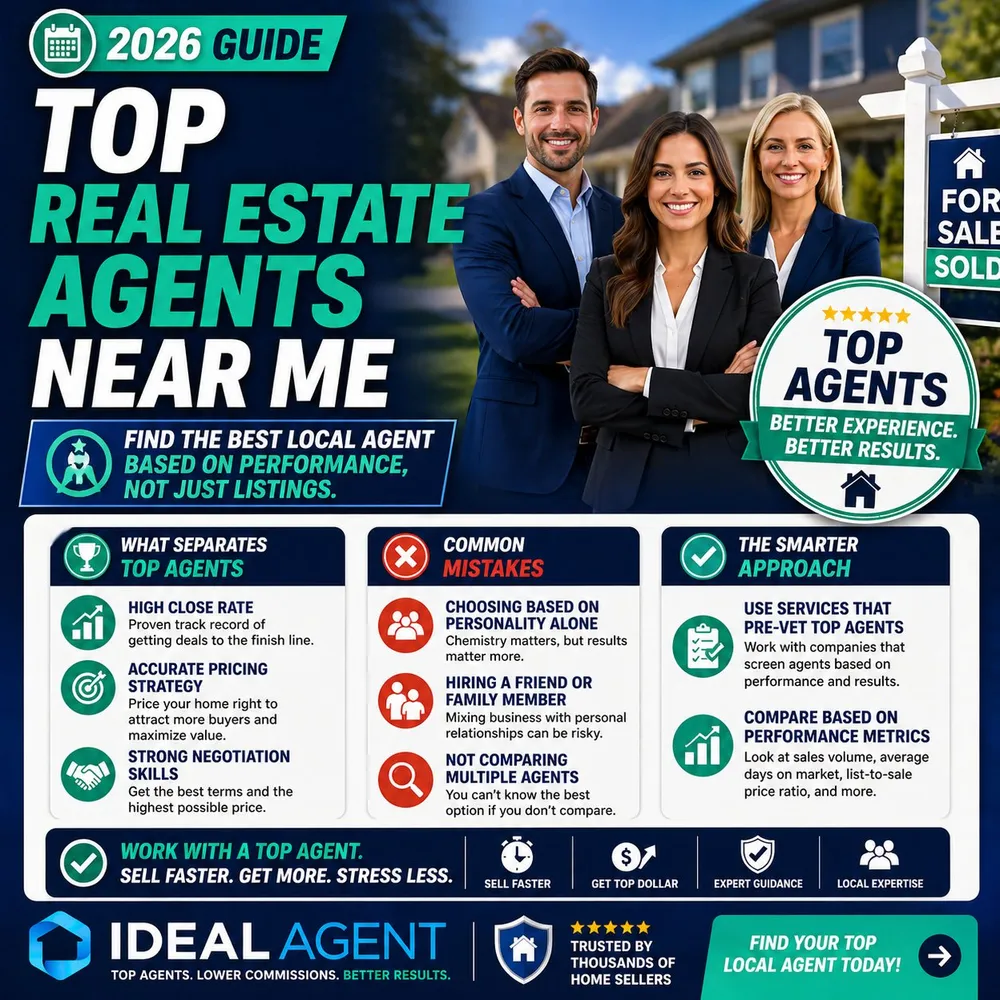
“Top real estate agent” is one of the most searched phrases in real estate — and one of the most misleading. Every agent claims to be top-rated. Zillow shows you whoever paid to be featured. Reviews can be manipulated. Referrals from friends are based on one data point.
Finding a genuinely top-performing agent requires looking at the data that actually predicts results — not marketing claims. Here’s exactly how to do it.
How Do You Find the Best Real Estate Agent Near You?
Short answer: Look at verifiable local performance data — sales volume in your specific zip code, average days on market versus the local baseline, and list-to-sale price ratios. Not reviews, not years of experience, not how confident they seem in the listing presentation.
What “Top Agent” Actually Means — In Numbers
The real estate industry uses the phrase “top agent” loosely. Here’s what it should actually mean:
Sales volume in your market. An agent who sells 5 homes a year has fundamentally different market knowledge than one who sells 50. Volume means they’re seeing current buyer behavior, pricing trends, and offer dynamics in real time.
Local specificity. An agent who primarily operates in a different neighborhood or price range is essentially a generalist in your market. Zip-code-level production data is the most relevant filter.
List-to-sale price ratio. This metric tells you what percentage of asking price their sellers actually receive. A ratio above 99% means their sellers consistently get near or above asking. A ratio of 95% means sellers are routinely leaving 5% on the table — which on a $400,000 home is $20,000.
Average days on market vs. local average. If the market average is 21 days and this agent’s listings average 35 days, something is wrong — with their pricing strategy, their marketing, or both.
The Metrics That Actually Predict Agent Performance
| Metric | What It Tells You | What to Look For |
|---|---|---|
| Homes sold in your zip code (last 12 months) | Local market depth | 10+ transactions |
| List-to-sale price ratio | Pricing and negotiation quality | 98–101%+ |
| Average days on market vs. local average | Marketing effectiveness | At or below local average |
| Price range experience | Relevant buyer network | Similar to your home’s price |
| Annual transaction volume | Full-time commitment | High volume relative to tenure |
| Listing vs. buyer representation split | Selling-side expertise | Majority on listing side |
| Recent sales in your neighborhood | Hyper-local knowledge | 3+ sales within 1 mile |
| Average sale price trend | Ability to maximize value | Rising or at market |
| Marketing quality (photos, tours, descriptions) | Presentation standards | Professional on every listing |
| Client reviews — seller-specific | Real seller experience | Detailed, recent, seller-focused |
Why the Most Common Ways People Find Agents Fail Them
Personal referrals. Your friend who used an agent two years ago had one transaction to evaluate them on. They don’t know the agent’s list-to-sale ratio or average days on market. It’s one data point presented with full confidence.
Online ratings and reviews. Most platforms allow agents to solicit reviews selectively. An agent with 150 five-star reviews may have had 200 transactions — 50 of which were unhappy clients who weren’t asked to review. Reviews tell you about likability. They tell you very little about performance.
Zillow’s “Premier Agent.” This is a paid placement. Featured position = marketing budget, not production quality.
Name recognition. Familiar names are often built through advertising spend, not transaction volume. Brand awareness and local market expertise are not the same thing.
How to Evaluate Agents Before You Interview Them
Check the MLS or public records. In most markets, you can search an agent’s name and see their recent transactions — what they listed, what it sold for, and how long it took. This is the most reliable data available.
Look at their active listings. Visit their current listings on Zillow or Realtor.com. Are the photos professional? Are the descriptions compelling? Do the listings show up well in search? This tells you what your listing will look like.
Check for recent neighborhood activity. An agent who has sold 3 homes on your street in the last 18 months knows things about buyer demand and pricing that no amount of general experience can replicate.
Questions to Ask Every Agent You Interview
- How many homes have you sold in my zip code in the last 12 months?
- What is your average list-to-sale price ratio?
- How do your listings’ days on market compare to the local average?
- Can you walk me through how you would price my home specifically?
- What does your marketing plan include — can I see examples?
- What is your commission, and what does it cover?
Red Flags That Indicate a Weak Listing Agent
Overpromising on price. An agent who tells you your home is worth significantly more than the comparable data supports is “buying the listing.” This costs sellers weeks of market time and often a lower final sale price.
Can’t provide specific local performance data. If an agent can’t tell you their list-to-sale ratio or their average days on market in your area, they either don’t know or the data doesn’t support sharing it.
Discourages you from interviewing other agents. A confident, high-performing agent welcomes comparison. One who discourages it is protecting information, not your interests.
Generic marketing plan. “I’ll list it on the MLS and put a sign in the yard” is not a marketing plan in 2026.
Frequently Asked Questions
How do I find a top real estate agent in my area?
Start with local MLS transaction data — how many homes has the agent sold in your zip code in the last 12 months, and what were their list-to-sale ratios? Alternatively, use a vetting service like IDEAL AGENT that screens agents on performance metrics and matches you with the top 1% in your market.
Does it matter if my agent is a buyer’s agent or a listing agent?
Yes — significantly. Listing and representing buyers require different skill sets. When selling, you want an agent who spends the majority of their time on the listing side. Ask any agent what percentage of their business is listings vs. buyer representation.
How many agents should I interview before hiring one?
Interview at least two, ideally three. Comparing agents side by side gives you context for evaluating pricing recommendations, marketing plans, and commission rates. Sellers who interview multiple agents consistently make better hiring decisions.
Ready to skip the research? IDEAL AGENT does the vetting for you — matching sellers with top 1% local agents at a pre-negotiated 2% listing commission. Free to use, no obligation.