Seller Closing Costs by State: 2026 Guide
-
 Research Team
 - 17 May, 2026
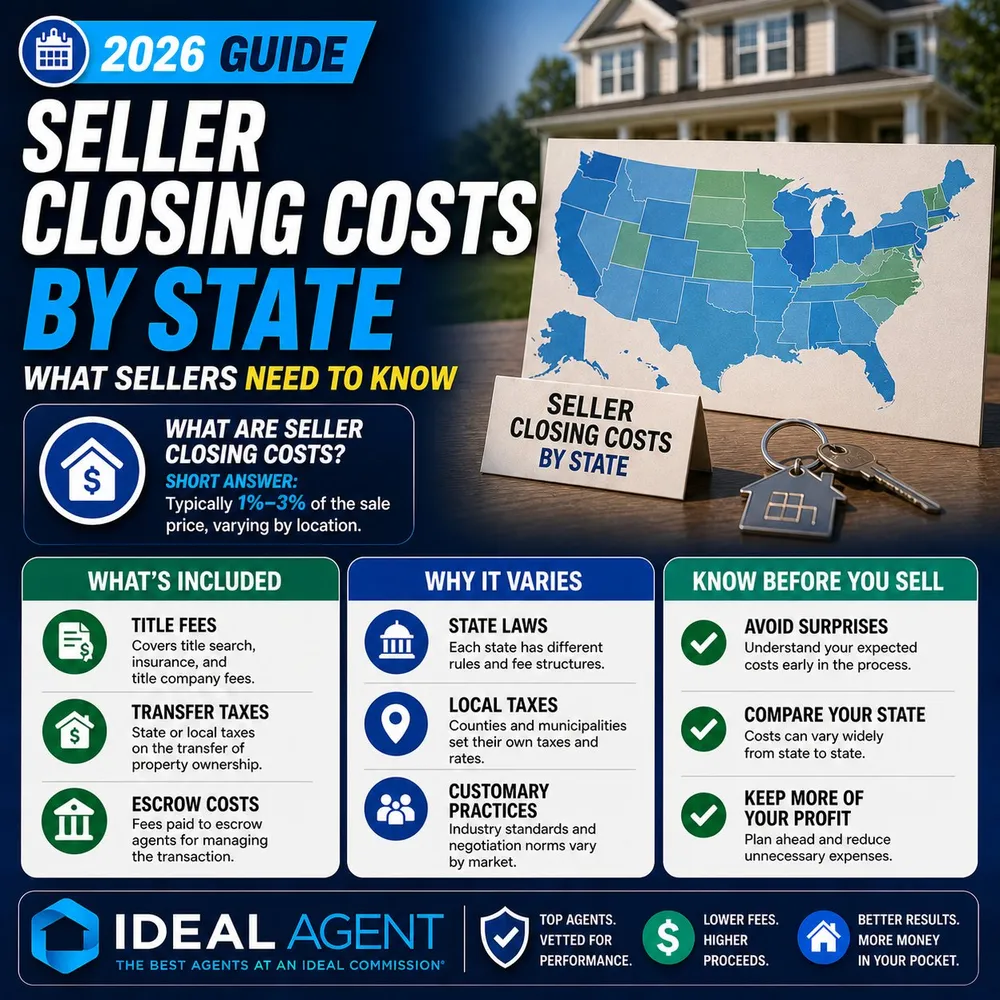
Closing costs catch sellers off guard more than almost any other expense. You’ve negotiated a great price, and then the closing statement arrives with a list of fees you didn’t fully anticipate. The total varies significantly depending on where you live — and knowing what to expect ahead of time puts you in control.
Short answer: Seller closing costs typically run 1%–3% of the sale price, not counting agent commission. On a $400,000 home, that’s $4,000–$12,000 in fees at closing. The exact amount depends on your state, county, and what’s customary in your local market.
What Are Seller Closing Costs?
Closing costs are fees and expenses paid at the closing table to complete the transfer of property ownership. They’re separate from agent commission — which is its own line item — and separate from any repairs or concessions you’ve agreed to.
Sellers typically pay a different set of costs than buyers, though there’s some overlap depending on local custom.
What’s Included in Seller Closing Costs
Title Fees
Title-related costs are usually the largest chunk of seller closing costs. These cover:
- Title search — a review of public records to confirm you have clear ownership and no outstanding liens
- Owner’s title insurance policy — a one-time premium that protects the buyer against future title claims; in many markets, sellers pay for this by custom
- Title company or settlement fees — compensation for the closing agent managing the transaction
Title fees vary significantly by state and title company. Shopping title companies (where permitted) can reduce these costs.
Transfer Taxes
Transfer taxes are government-imposed fees on the transfer of property ownership. They vary enormously by location:
- Some states have no transfer tax at all (Texas, Wyoming, Montana)
- Others charge a flat rate of 0.1%–0.5% of the sale price
- High-tax states and cities can charge 1%–4%+ (New York City, for example, charges some of the highest transfer taxes in the country)
In most markets, the seller pays transfer taxes — but local custom varies, and it’s sometimes negotiable.
Escrow Costs
If a neutral escrow company manages the transaction (common in Western states), both parties pay escrow fees. The seller’s portion typically runs $500–$1,500 depending on the sale price and company.
In attorney states (common in the Northeast and Southeast), a real estate attorney handles the closing instead of an escrow company.
Other Common Seller Costs at Closing
- Prorated property taxes — you pay taxes for the portion of the year you owned the home
- HOA fees — prorated dues, transfer fees, and any outstanding assessments
- Home warranty — if you agreed to provide one ($300–$600)
- Recording fees — government fees to record the deed transfer ($50–$250)
- Courier/wire fees — small administrative costs
Seller Closing Costs by Region
While every transaction is different, here’s a general guide by region:
| Region | Typical Seller Closing Costs (excl. commission) | Notes |
|---|---|---|
| Northeast (NY, NJ, MA, CT) | 2%–4%+ | High transfer taxes; attorney required |
| Mid-Atlantic (PA, MD, DC, VA) | 2%–3% | Transfer taxes vary significantly by state |
| Southeast (FL, GA, NC, SC) | 1%–2% | Generally lower; attorney states |
| Midwest (IL, OH, MI, MN) | 1%–2% | Transfer taxes moderate; escrow common |
| Southwest (TX, AZ, NV, CO) | 1%–2% | TX has no transfer tax; escrow common |
| West Coast (CA, WA, OR) | 1%–2% | Escrow-based; county transfer taxes vary |
| Mountain West (ID, UT, MT, WY) | 0.5%–1.5% | Lower overall closing costs |
Why Closing Costs Vary So Much
Three main factors drive the differences:
State Laws
Each state sets its own rules for what fees are required, who pays them, and how much transfer taxes cost. Some states mandate attorney involvement; others don’t. These structural differences create wide variation before any negotiation happens.
Local Taxes
County and municipal governments layer their own transfer taxes on top of state taxes. In some counties, the combined state + local transfer tax can approach 3%–4% of the sale price on its own.
Customary Practices
Even within the same state, local market customs determine who pays what. In some markets, sellers customarily pay for the owner’s title insurance policy; in others, buyers do. These norms vary by county and even city, and your agent should know them.
How to Reduce Your Closing Costs
Get a Net Sheet Early
Before you list, ask your agent or title company for a seller’s net sheet — an estimate of all costs and your projected proceeds. This eliminates surprises and helps you plan.
Shop Title and Escrow Services
In states where you’re permitted to choose your own title company, getting quotes from 2–3 providers can save hundreds to thousands of dollars. Fees are not regulated uniformly.
Negotiate What’s Negotiable
Transfer taxes are set by law and not negotiable. But escrow fees, home warranty inclusion, and some title fees may have flexibility — especially in a seller’s market where you have leverage.
Work With a Low-Commission Agent
Commission is your largest selling cost, and reducing it by even 1% on a $400,000 home saves $4,000. IDEAL AGENT pre-negotiates lower commission rates with top local agents so you save without sacrificing representation quality.
What Your Closing Disclosure Will Show
Before closing, you’ll receive a seller’s closing disclosure (or settlement statement) itemizing every cost. Review it carefully at least 24 hours before closing. Common errors include:
- Incorrect payoff amounts
- Duplicate fees
- Prorations calculated on wrong dates
- HOA charges that don’t match what the HOA confirmed
Your agent should review this with you. Flag anything that looks unfamiliar or doesn’t match what was agreed.
Frequently Asked Questions
Do sellers always pay closing costs?
Sellers pay certain costs by law or custom (transfer taxes, their share of title fees). Buyers pay others. In some transactions, sellers agree to cover a portion of the buyer’s closing costs as a concession — this comes out of your proceeds and reduces your net.
Are closing costs paid out of pocket or from proceeds?
In the vast majority of sales, closing costs are deducted from your proceeds at closing. You don’t bring a check — the title company or escrow officer accounts for everything and wires you the net amount.
Can the buyer pay my closing costs?
Not directly — but a buyer can offer a higher purchase price to offset costs, or you can negotiate who pays what. Some costs (like transfer taxes) are legally assigned to one party and can’t be shifted.
How do I find out what closing costs are in my state?
Your real estate agent and title company are your best resources. Ask for a seller’s net sheet specific to your transaction early in the process — ideally before you list.
Do closing costs affect capital gains tax?
Yes — selling costs including closing fees can be added to your adjusted cost basis, which reduces your capital gain. Keep all closing documents and consult a CPA when you file.
Understanding your full cost picture before you list is one of the most important things you can do as a seller. IDEAL AGENT connects you with a top local agent who will walk you through every number — and help you keep more of what your home is worth.