Red Flags When Hiring a Real Estate Agent
-
 Research Team
 - 16 May, 2026
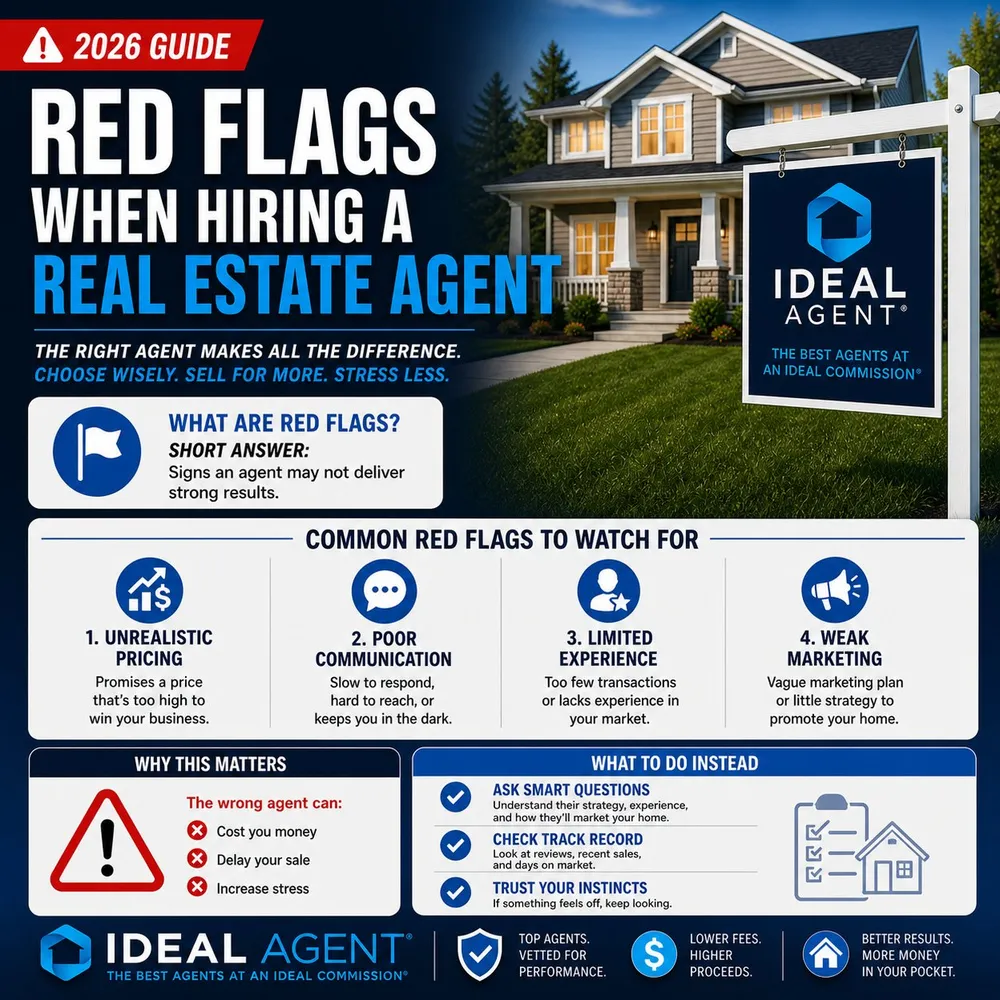
Most sellers only go through the agent-hiring process a few times in their life — which means most sellers don’t know what bad looks like until they’re already locked into a listing agreement. Knowing the warning signs before you sign can save you months of frustration and thousands of dollars in lost proceeds.
Short answer: Red flags are signs that an agent may not deliver the results you need. The most dangerous ones — unrealistic pricing, weak marketing, poor communication, and limited experience — are all visible before you sign if you know what to look for.
Why Choosing the Wrong Agent Is So Costly
A bad listing agent doesn’t just fail to help — they actively hurt your outcome. Here’s how:
- Overpricing kills momentum. An agent who pushes an unrealistic list price wastes your best weeks on market and stigmatizes your home.
- Weak marketing means fewer buyers. Every buyer who doesn’t see your home is an offer you didn’t get.
- Poor negotiation gives away money. Inexperienced negotiators routinely concede price, repairs, and terms that a stronger agent would have defended.
- Poor communication costs deals. Missed deadlines, confused buyers, and disorganized transactions fall apart.
The wrong agent in the wrong market can easily cost a seller 3%–8% of their home’s value. On a $500,000 home, that’s $15,000–$40,000.
Red Flag #1: Unrealistic Pricing
This is the most dangerous red flag and the hardest to spot in the moment — because it feels good. An agent who tells you your home is worth more than the market data supports is telling you what you want to hear, not what you need to know.
This practice is called “buying the listing.” The agent suggests an inflated number to win your business. Once they have your signed listing agreement, reality sets in: the home sits, the agent pressures you to reduce, and your final sale price is lower than it would have been had you priced correctly from the start.
How to spot it:
- One agent’s suggested price is $20,000–$50,000 higher than all the others
- They can’t point to specific recent comparable sales that justify the price
- They dismiss your questions about comps with vague assurances
- They’re enthusiastic about the price but thin on data
What to do: Ask every agent for the 3–5 specific comparable sales that support their price recommendation. If they can’t produce them, the price isn’t real.
Red Flag #2: Poor Communication
How an agent communicates during the interview is exactly how they’ll communicate during your listing. If it took two days to return your call when you were a potential new client, imagine the delays when you need a quick answer during a contract negotiation.
Signs of poor communication:
- Slow to respond to initial inquiry (24+ hours)
- Vague or incomplete answers to direct questions
- Doesn’t ask questions about your situation, timeline, or goals — just talks
- Can’t clearly explain their process
- Deflects questions about their track record
Communication issues cascade. A buyer’s agent who can’t reach your listing agent loses interest and moves their client to another home. Deal timelines are missed. Problems don’t get solved. Deals fall apart.
Red Flag #3: Limited Experience or Stale Activity
Years licensed doesn’t equal competence. What matters is current, local transaction activity. An agent who sold 30 homes a decade ago but has been doing only 3–4 per year recently is operating on stale knowledge.
Warning signs:
- Few or no recent sales in your neighborhood or price range
- Can’t name active buyers in your price bracket
- Unfamiliar with current inventory levels or recent sales
- Works across too many geographic areas to know any of them well
- No verifiable recent transaction history you can review
Ask specifically: “How many homes have you listed and sold in this zip code in the past 12 months?” A strong local agent answers this immediately and specifically.
Red Flag #4: Weak or Vague Marketing Plan
“I’ll put it on the MLS and we’ll do some open houses” is not a marketing plan. It’s the minimum possible activity, dressed up as a strategy.
Buyers are everywhere — online, on social media, getting emails from their agent. A serious listing agent has a systematic way of reaching all of them. If an agent can’t clearly articulate their promotional approach before you sign, expect very little promotion after.
A real marketing plan includes:
- Professional photography (non-negotiable)
- Video walkthrough or 3D tour
- MLS listing + syndication to all major platforms
- Targeted social media advertising
- Outreach to buyer’s agents with active clients in your range
- Email marketing to the agent’s database
- Strategic open house plan
A red flag marketing plan says:
- “I have a large network”
- “We’ll see how it goes the first weekend”
- “The MLS does most of the work”
Red Flag #5: Pressure to Sign Immediately
A confident, quality agent lets their track record do the talking. They welcome questions, encourage you to interview other agents, and are comfortable giving you time to decide.
An agent who pressures you to sign at the first meeting — offering special deals if you “decide today,” discouraging you from interviewing others, or creating artificial urgency — is not acting in your interest.
What this signals: They’re not confident their results will win you over in a fair comparison.
Red Flag #6: They Can’t Tell You Their List-to-Sale Price Ratio
Every serious listing agent tracks how close their final sale prices are to their list prices. A strong agent should be able to tell you their list-to-sale ratio readily — and it should be at or above the local market average.
An agent who doesn’t know this number, or who deflects when you ask, hasn’t been paying attention to their own performance. That’s a serious problem.
Red Flag #7: They Recommend Skipping Professional Photography
This is a dealbreaker. Professional photography is standard practice. An agent who suggests phone photos, or who doesn’t include photography in their standard listing package, is cutting corners on the single most visible element of your marketing — before a single buyer walks through the door.
If they’re cutting corners here, where else are they cutting them?
Red Flag #8: No Clear Transaction Management Process
Most sellers don’t think much about what happens between accepted offer and closing — but that 30–45 day period is when deals most often fall apart. A strong listing agent actively manages inspections, appraisals, lender timelines, title work, and all the moving pieces.
Ask: “What does your process look like from accepted offer to closing?” A vague answer suggests they’re not actively managing the transaction — and one missed deadline or overlooked document can kill a deal.
What to Do When You See Red Flags
Trust your instincts. If something feels off during the interview, it will be worse under pressure. You’re not obligated to sign with anyone.
The best protection is a structured hiring process:
- Interview at least 2–3 agents
- Ask the same questions of each
- Request verifiable data — not just references
- Read listing agreement terms carefully before signing (especially the duration and cancellation terms)
IDEAL AGENT eliminates most of this uncertainty by pre-vetting agents on performance data before any seller ever meets them. Our agents are vetted on list-to-sale ratio, days on market, local transaction volume, and client satisfaction — so the red flags are screened out before they reach you.
Frequently Asked Questions
What’s the most common red flag sellers miss?
Unrealistic pricing. It feels like good news in the moment, so sellers don’t question it. By the time the home has been sitting for 45 days and they’re taking their third price reduction, the damage is done.
Can I fire my agent if I’m not happy?
It depends on your listing agreement. Most have a term of 3–6 months. Some include an early termination clause; many don’t. Review your agreement carefully before signing. Some agents will let you out if you ask — especially if they know they haven’t performed.
Is it rude to interview multiple agents?
Not at all. Good agents expect and respect it. Sellers who interview multiple agents consistently make better hiring decisions.
What should I do if my agent stops communicating mid-listing?
First, document your attempts to reach them. Then contact their broker directly — agents work under a supervising broker who is responsible for their conduct. If you can’t get resolution, consult a real estate attorney about your options under your listing agreement.
How do I know if an agent’s marketing is actually working?
Ask for a weekly activity report: number of showings, showing feedback from buyer’s agents, online listing views, and any buyer inquiries. If they can’t or won’t produce this, your marketing isn’t being tracked — or done.
The right agent makes your sale. The wrong one breaks it. IDEAL AGENT takes the guesswork out of hiring by matching you with pre-vetted, top-performing local agents — so you start with confidence, not hope. Get matched for free today.