15 Questions to Ask a Listing Agent Before You Hire Them
-
 Research Team
 - 04 May, 2026
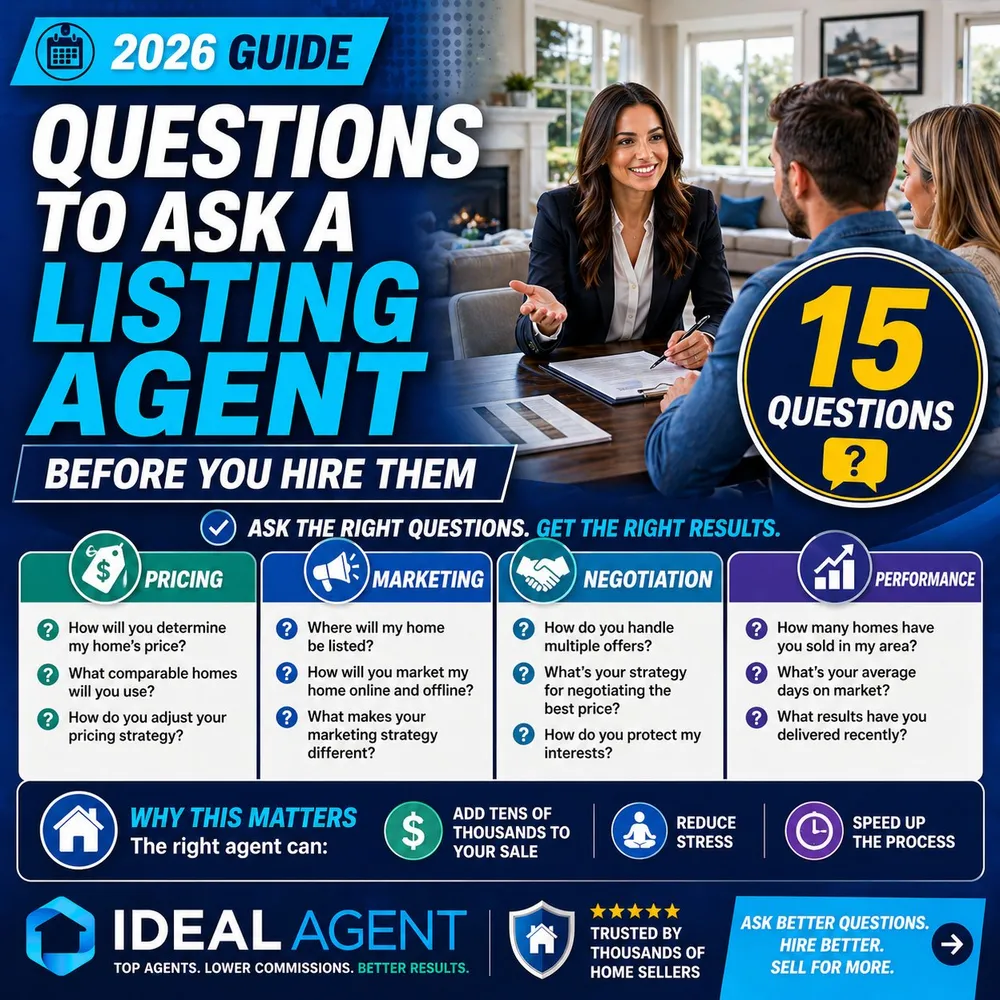
Most sellers interview one agent, hear what they want to hear, and sign. That’s a mistake that costs thousands. The right questions — asked before you sign — separate top-performing agents from average ones faster than any review or referral.
Here are the 15 questions that reveal the most, and exactly what strong vs. weak answers look like.
What Should You Ask a Listing Agent Before Hiring Them?
Short answer: Ask about their local production data, pricing methodology, specific marketing plan, negotiation track record, and commission structure. Vague answers to any of these questions are a red flag. Strong agents have specific, data-backed answers to all of them.
Pricing Questions
1. How did you arrive at this listing price recommendation?
Why it matters: Pricing is the highest-leverage decision in your sale. An agent who can’t explain their methodology in detail is either guessing or telling you what you want to hear.
Strong answer: Walks you through specific comparable sales within the last 60–90 days, within a defined geographic radius, with adjustments for differences in size, condition, and features. Shows you the CMA in writing.
Weak answer: “Based on my experience, I think we can get X.” No comps. No data. No adjustments. Just a number.
2. What would you recommend if the home doesn’t receive strong offers in the first two weeks?
Why it matters: A good agent has a specific, proactive plan for this scenario. A mediocre agent either hasn’t thought about it or will tell you what you want to hear now and ask for a price reduction later.
Strong answer: Specific criteria for when to consider a price adjustment, a marketing reassessment process, and a frank conversation about the implications of sitting on market.
Weak answer: “We’ll cross that bridge when we come to it” or “I’m confident it’ll sell.”
3. Are there any features of my home that might make pricing or selling more challenging?
Why it matters: You want an agent who will be honest about your home’s challenges upfront — not one who sugarcoats everything to win your business, then struggles once the listing is live.
Strong answer: Specific, honest feedback about features that may require pricing adjustments or disclosures — a busy road, deferred maintenance, dated systems, unusual floor plan.
Weak answer: “Your home is great, I don’t see any issues.”
Marketing Questions
4. What does your complete marketing plan look like?
Why it matters: Marketing quality determines how many qualified buyers see your home — and how motivated they are. A weak marketing plan means a smaller buyer pool, fewer offers, and less leverage.
Strong answer: Specific plan including professional photographer (with portfolio to show), 3D virtual tour, MLS listing with complete details, social media targeted ad campaigns, agent database email blast, and “coming soon” pre-launch strategy.
Weak answer: “I’ll list it on the MLS, put a sign in the yard, and hold open houses.” This is 2005 marketing.
5. Can I see examples of your recent listings?
Why it matters: Their current and recent listings tell you exactly what your listing will look like. Look at photo quality, description quality, and presentation.
Strong answer: Immediately pulls up 2–3 recent listings with professional photography, compelling descriptions, and complete information.
Weak answer: Hedges, can’t quickly show examples, or shows listings with poor photos or sparse descriptions.
6. How will you market my home to buyers who aren’t actively searching online?
Why it matters: The best buyer for your home might be someone who isn’t actively searching yet — but who would move quickly if the right property appeared in front of them. Strong agents have buyer databases and relationships that go beyond MLS syndication.
Strong answer: Describes an active buyer database, relationships with buyer’s agents who have active clients in your price range, and outreach strategies that go beyond passive MLS syndication.
Weak answer: “Once it’s on Zillow, buyers will find it.”
Performance Questions
7. How many homes have you sold in my zip code in the last 12 months?
Why it matters: Local production volume is the most predictive indicator of current market knowledge. An agent with 15 local transactions in the last year is seeing buyer behavior, pricing trends, and competing inventory in real time.
Strong answer: Specific number, with names of streets or neighborhoods as supporting detail. Can describe recent buyer demand patterns in your area.
Weak answer: Can’t answer specifically, pivots to total career transactions or general market experience.
8. What is your average list-to-sale price ratio?
Why it matters: This metric tells you what percentage of asking price their sellers actually receive. A ratio below 97% means their sellers are routinely accepting significantly below asking — whether from overpricing or negotiation weakness.
Strong answer: Provides a specific number — ideally 98–101% — and can contextualize it relative to the local market average.
Weak answer: “It depends on the market” or can’t provide the number.
9. How does your average days on market compare to the local average?
Why it matters: Fast sales happen to well-priced, well-marketed homes. If this agent’s listings consistently sit longer than the local average, something is off — pricing, marketing, or both.
Strong answer: Provides a specific number and compares it to the local market average, with explanation of what drives the performance.
Weak answer: “It varies” or doesn’t know the number.
Negotiation Questions
10. Walk me through a recent situation where your negotiation made a material difference for a seller.
Why it matters: Strong negotiators have specific stories. Agents who haven’t produced standout negotiation outcomes pivot to generic answers about “advocating for my clients.”
Strong answer: A specific transaction — the situation, what was at stake, what they did, and the measurable outcome (price saved, concession avoided, deal saved).
Weak answer: Generic statements about “fighting hard for my clients” with no specific example.
11. How do you handle multiple offers?
Why it matters: Managing a multiple-offer situation is both an art and a science. A skilled agent knows how to create urgency, communicate competing interest legally and ethically, and structure the offer deadline process to maximize your leverage.
Strong answer: Specific process — setting offer deadlines, communicating competing interest to buyer’s agents, evaluating offers holistically (not just price), and using competition to improve terms.
Weak answer: “I review them and let you decide” — no strategy, no process.
12. How do you typically handle inspection repair requests?
Why it matters: Post-inspection negotiation is where many deals lose value. Sellers who capitulate to every repair request, or who agree to credits without strategic thinking, leave money on the table.
Strong answer: Describes a specific framework — what to address vs. what to decline, how to offer credits strategically, when to hold firm, and how to respond to unreasonable demands.
Weak answer: “We try to work with the buyer” — no strategy.
Commission and Process Questions
13. What is your commission, and what exactly does it include?
Why it matters: Commission rates vary, and so does what they cover. Some agents include professional photography; others charge extra. Know the full cost picture before comparing.
Strong answer: Specific percentage, clear list of what’s included (photography, 3D tour, transaction management), and transparency about any additional costs.
Weak answer: Vague about what’s included, or pivots away from the question.
14. Is your commission negotiable?
Why it matters: Commission is always negotiable. An agent who says it isn’t is either uninformed or being evasive. A confident, high-performing agent will negotiate — or will clearly explain why their rate is what it is.
Strong answer: Direct answer — either “yes, here’s what flexibility I have” or “my rate is X because of Y, and here’s the value that justifies it.”
Weak answer: “Commission is standard” or deflection.
15. How will you communicate with me throughout the process, and what response time should I expect?
Why it matters: Real estate transactions move fast. Missed communications during an offer deadline or inspection period can cost you the deal or the best terms. Know what you’re signing up for.
Strong answer: Specific communication cadence — how often you’ll receive updates, preferred channels, typical response time, and who covers when they’re unavailable.
Weak answer: “I’m always available” with no specifics — this often means they’re available until you sign.
How to Evaluate the Answers
After your interviews, compare agents on:
| Question Category | What Strong Answers Have | What Weak Answers Have |
|---|---|---|
| Pricing | Specific comps, written CMA | Confident guesses, no data |
| Marketing | Named vendors, specific timeline | Generic descriptions |
| Performance | Actual numbers and ratios | Years of experience |
| Negotiation | Specific stories | Generic assurances |
| Commission | Clear scope, honest negotiation | Deflection or “standard” |
The agent who gives the most specific, data-backed answers to these 15 questions is almost always the agent who will produce the best outcome.
Frequently Asked Questions
How many listing agents should I interview?
At minimum two, ideally three. Seeing agents side by side gives you context you can’t get from a single presentation. Sellers who interview multiple agents make better decisions and are more confident in their choice.
Should I always hire the agent with the lowest commission?
No. The goal is the highest net proceeds at closing — not the lowest commission rate. A top-performing agent at 2% who generates competing offers and negotiates strongly will consistently outperform a 1% agent who produces weak results. With IDEAL AGENT, you can get top 1% performance at 2% — eliminating the trade-off.
What if the agent is a friend or family member?
Ask them the same 15 questions. If their performance data is strong and their marketing plan is specific, hire them. If it isn’t, the kindest thing for both your financial outcome and your relationship is to work with someone else.
Ready to work with an agent who can answer every one of these questions with confidence and data? IDEAL AGENT matches you with top 1% local agents at a pre-negotiated 2% listing commission. Free to get started — no obligation.