Open House vs. Private Showings: Which Sells Homes Faster?
-
 Research Team
 - 05 Jun, 2026
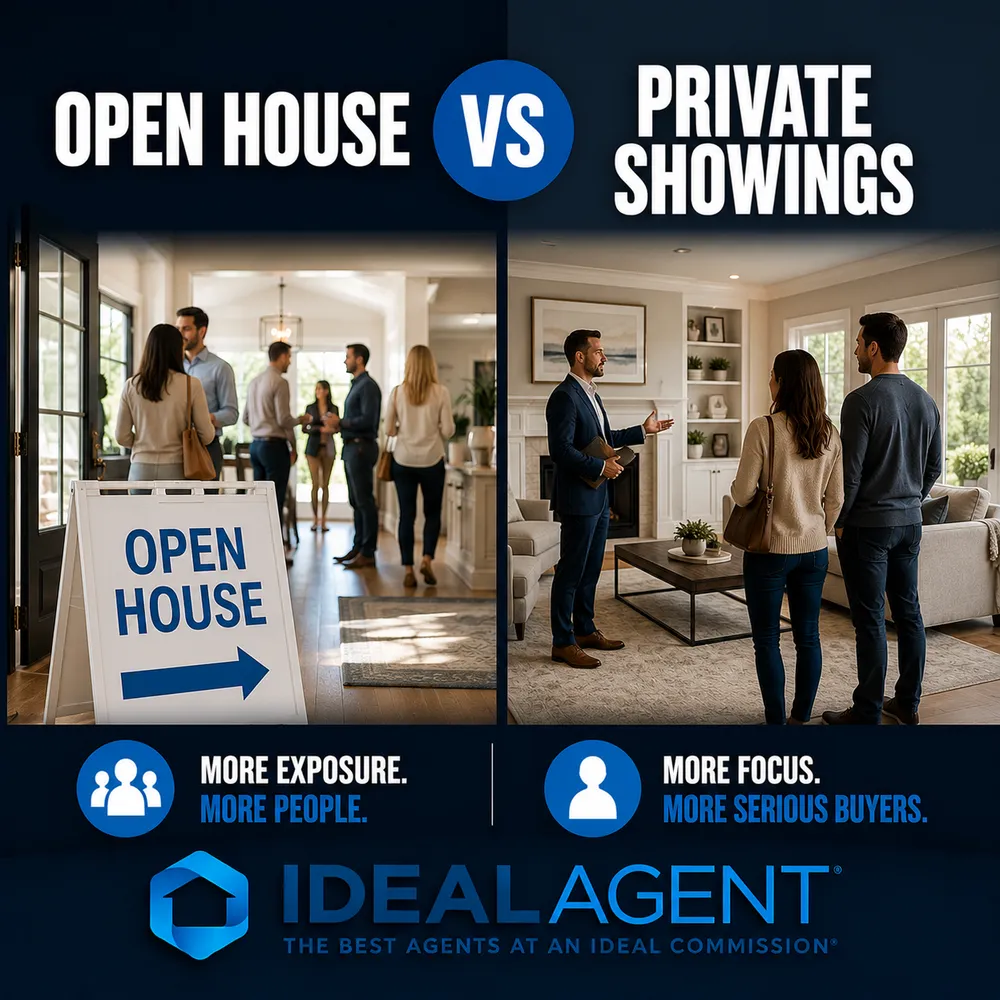
The open house vs. private showings debate has been part of real estate strategy for decades. Some agents swear by open houses as essential traffic drivers; others argue they attract nosy neighbors and curious lookers rather than serious buyers. The reality is more nuanced — and the right answer depends on your market conditions, price point, and how your listing is positioned.
Short answer: Both open houses and private showings play a role in a complete marketing strategy. Private showings are where serious buyers make decisions. Open houses create urgency and social proof that motivates those buyers to act. The best approach uses both, timed correctly.
What Open Houses Actually Do
Open houses serve three distinct purposes in a listing strategy — some more valuable than others.
1. Generate showing traffic early in the listing cycle The first weekend on market is your most powerful marketing window. A well-promoted open house can bring 20–50 people through the home in a single afternoon, building a base of buyer awareness that would take weeks to achieve through private showings alone.
2. Create social proof and urgency When a buyer walks into an open house and sees five other couples also looking seriously, it triggers urgency. The fear of missing out — “if I don’t act, someone else will” — is a real psychological driver. Open houses create this dynamic in a way that private showings cannot.
3. Convert casual interest into serious buyers Some buyers are not yet committed enough to schedule a private showing but will attend an open house. Getting them inside the home and falling in love with it can convert passive interest into a real offer.
What open houses are NOT good at:
- Converting neighbors and curiosity visitors into buyers (they won’t buy your home, but the traffic looks impressive)
- Replacing quality marketing — an open house with no promotion and no digital advertising is nearly worthless
- Securing buyers in markets where every buyer is already represented by an agent who will schedule private showings
What Private Showings Actually Do
Private showings are where serious buyers make their decision. A buyer who schedules a private showing through their agent has already:
- Seen the listing online and been sufficiently impressed to schedule
- Discussed the property with their agent
- Pre-approved their financing or confirmed cash capacity
- Set aside time specifically to evaluate this home
Private showing buyers are, in aggregate, more qualified and more serious than open house visitors. The conversion rate from private showing to offer is significantly higher.
Private showings also allow:
- A slower, more comfortable walk-through without strangers present
- Honest conversation between buyer and their agent about concerns
- Second visits for measurement, design planning, or bringing family members
- The buyer to spend as much time as they need without feeling rushed
The Real Data: Do Open Houses Sell Homes?
The question of whether open houses directly generate sales is genuinely contested. Multiple industry studies suggest that only 3–5% of homes are sold directly to buyers who first encountered them at an open house. The vast majority of homes sell to buyers who scheduled private showings.
However, this data misses an important dynamic: open houses generate initial awareness that leads to private showings, which lead to offers. The sale is credited to the private showing — but the open house may have been the first touch point. Attributing causality is difficult.
What’s consistently true:
- Open houses in the first 1–2 weekends on market generate more traffic and more offers than later open houses
- Open houses paired with strong digital promotion outperform open houses with only a yard sign
- In slow markets, open houses create the urgency and social proof that private showings in isolation don’t generate
- In hot markets with multiple offers, open houses may be redundant — buyers are already competing through private showings
When Open Houses Are Most Valuable
Open houses deliver the highest ROI in these situations:
- First 1–2 weekends on market — when buyer interest and online listing views are highest
- Slow or balanced markets — where private showing traffic is lower and urgency needs to be manufactured
- Competitively priced homes at entry-level price points — where a larger buyer pool increases the probability of open house attendees becoming buyers
- High foot-traffic neighborhoods — where weekend passersby can be converted to in-home visitors by a sign and a curious glimpse
When Open Houses Are Less Critical
Open houses have lower marginal value when:
- Your market is a strong seller’s market — buyers are already competing and private showing traffic is high. Adding an open house doesn’t significantly increase buyer count.
- Your home is in the luxury segment — luxury buyers typically tour by private appointment, and open houses may not attract the right buyer profile. Invitation-only broker’s opens to qualified buyer’s agents are more effective.
- Security is a concern — occupied homes with valuables, home offices with sensitive information, or sellers who are protective of their privacy may reasonably limit open house access.
Broker’s Opens: The Underutilized Tool
A broker’s open house — an open house specifically for real estate agents rather than the public — is one of the most effective and underutilized marketing strategies in real estate.
When your agent hosts a broker’s open (typically on a Tuesday or Wednesday morning), they invite every active buyer’s agent in the area to preview the home. Agents who attend will immediately think of their buyer clients who fit the profile. Many showings and offers originate from buyer’s agents who saw a home at a broker’s open and matched it to a client.
A well-promoted broker’s open at launch is particularly powerful and should be a standard part of any listing’s first week marketing.
How to Get the Most From Open Houses
If you’re hosting open houses, these practices make them significantly more effective:
Promote aggressively. A yard sign is not a marketing strategy. Your agent should promote the open house via social media advertising (targeted to buyers in your geographic and demographic profile), email to buyer’s agents, and listing portal event listings at minimum.
Time it right. Saturday and Sunday afternoons (typically 1–4 PM) are standard. Launching on Thursday and holding an open house the following weekend gives online listing views time to build before the event.
Prepare as if it’s a showing. Every open house visitor is a potential buyer or knows one. The home should be staged, lit, and presented at its absolute best.
Gather feedback. Your agent should collect contact information from every visitor and follow up immediately. Open house attendees who don’t make an offer sometimes circle back — and their stated objections provide pricing and condition intelligence.
Don’t overdo it. An open house every weekend after the first month signals that the home isn’t selling — which is the opposite of the social proof you’re trying to create. Limit open houses to the first 2–3 weeks and after any significant price adjustment.
Showing Accessibility: The Variable Sellers Most Underestimate
Regardless of open house strategy, the single most important showing variable is accessibility. Homes that are easy to show — lockbox access, same-day availability, no advance notice required — get more showings. More showings mean more offers. More offers mean better outcomes.
Every restriction you place on showings has a cost:
- “24-hour notice required” → buyer’s agent skips to the next available listing
- “No showings before 10 AM or after 6 PM” → misses working buyers who can only tour in evenings
- “Must coordinate with tenant” → unpredictable access that frustrates buyer’s agents
Remove every restriction you reasonably can.
How Your Agent’s Network Drives Showing Traffic
The best source of showing traffic — open house or private — is your agent’s professional network. An agent who actively sells in your market has direct relationships with the buyer’s agents working that same market. When your agent calls those agents, tells them about a new listing that fits their buyer’s profile, and invites them to the broker’s open, they’re generating targeted showing traffic that no amount of digital advertising can fully replicate.
This is one of the clearest advantages of hiring a top-performing local agent through IDEAL AGENT. Top 1% agents have the networks, the market presence, and the professional relationships that generate showing activity beyond what the MLS alone produces. And at a 2% listing commission — well below the traditional 2.5–3% — that high-performance marketing comes with better economics for the seller. If a buyer comes directly through your agent’s marketing without a separate buyer’s agent, total commission is just 2%. When a buyer’s agent is involved, IDEAL AGENT recommends a competitive 2–2.5% buyer’s agent commission.
Open House vs. Private Showing: Summary
| Factor | Open House | Private Showing |
|---|---|---|
| Buyer qualification | Mixed (neighbors, curious visitors, serious buyers) | Higher — scheduled by represented buyers |
| Urgency creation | High — social proof from other visitors | Lower — one-on-one visit |
| Conversion rate to offer | Lower per visitor | Higher per visitor |
| Best timing | First 1–2 weekends on market | Throughout listing period |
| Value in slow markets | High | High |
| Value in hot markets | Moderate | Very high |
| Luxury properties | Low (prefer broker’s opens) | Very high |
| Security flexibility required | Lower | Higher |
Frequently Asked Questions
Do I have to allow open houses when selling my home?
No — open houses are optional, not required. If you have security concerns, privacy needs, or a tenant-occupied property, you can decline. However, understand the trade-off in marketing reach, especially early in the listing.
How many open houses should I have?
One to two in the first two weekends on market is standard. After that, open houses only make sense after a price adjustment or if private showing activity has been unusually low.
Should I be home during open houses?
No — sellers should not be present during open houses or private showings. Buyers feel uncomfortable speaking freely when the seller is in the room, which reduces the quality of the showing experience.
Are virtual open houses effective?
Virtual open houses (live video tours, Zoom walk-throughs) have utility in specific situations — relocation buyers, early-stage researchers, or buyers in out-of-state markets. They don’t replace in-person showings for serious local buyers but can extend your marketing reach meaningfully.
How do I know if my open house was successful?
Your agent should report on total visitors, contact information collected, feedback gathered, and any follow-up inquiries that emerged. An open house that brings 25 visitors and generates 4 follow-up showing requests is successful even if no offers arrive the same day.
Open houses and private showings work best together — and both are maximized by the right agent executing a full marketing strategy. Get matched with a top local agent through IDEAL AGENT, list at 2% commission, and get the showing strategy your home deserves from the first day on market.