Mortgage Rates Hit 7.24%: What Sellers Should Know
-
 Research Team
 - 17 Sep, 2026
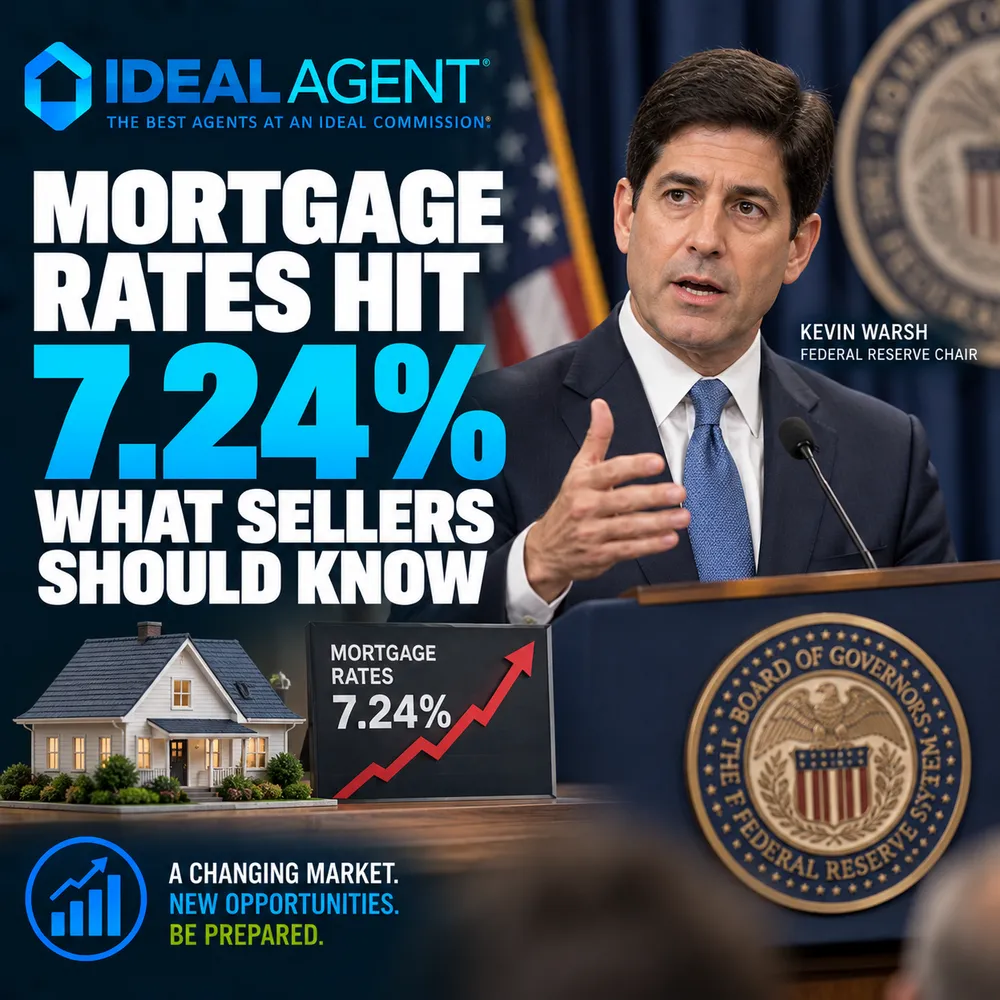
The Federal Reserve just delivered its first rate hike in three years, and mortgage rates followed the broader trend that’s been building for months. For sellers, the headline number matters less than what it does to the buyer sitting across the table from your listing.
Short answer: On September 16, the Federal Reserve raised its benchmark rate by 0.25 percentage point to a target range of 3.75%–4.00%, its first increase since 2023. The same day, the average top-tier 30-year fixed mortgage rate climbed to 7.24%. Higher mortgage rates don’t stop homes from selling, but they reduce what buyers can afford — which means pricing accuracy and strong marketing matter more now than they did when rates were lower.
What Did the Fed Actually Do?
The Federal Open Market Committee voted unanimously, 12–0, to raise the federal funds rate by a quarter point to a target range of 3.75%–4.00%, citing inflation that remains above its 2% target. This was the Fed’s first rate increase since 2023, following a period of cuts and a extended hold. Updated projections released alongside the decision suggested several committee members see another increase as possible later this year, meaning this may not be a one-time move.
Does the Fed Directly Set Mortgage Rates?
No. The federal funds rate is an overnight bank-to-bank lending rate, not a mortgage rate. Mortgage rates are driven primarily by the bond market, Treasury yields, and inflation expectations, and they often move in anticipation of Fed decisions rather than strictly in response to them. In this case, mortgage rates had already been climbing for weeks before the September 16 announcement, as markets priced in the likelihood of a hike.
How High Did Mortgage Rates Actually Go?
The average top-tier 30-year fixed mortgage rate reached 7.24% on September 16 — the highest level in roughly a year. Different rate-tracking sources show slightly different numbers depending on methodology (weekly survey averages tend to run lower than daily top-tier lock rates), but the direction is consistent across all of them: rates have moved up meaningfully since earlier this year, when 30-year rates were closer to 6%.
Is 7% the “New Normal”?
National Association of Realtors Chief Economist Lawrence Yun said as much following the Fed’s decision, noting that sellers and buyers should be prepared for rates to stay in the 7% range for a while. He pointed to persistent inflation, elevated oil prices, and government borrowing as factors keeping long-term rates elevated, while noting that a meaningful decline would likely require oil prices retreating, a credible deficit-reduction plan, or a productivity boost from new technology — all of which remain uncertain in the near term.
Why Does a Higher Mortgage Rate Matter If You’re Selling, Not Buying?
You don’t make the buyer’s mortgage payment, but the rate they’re financing at determines how much home they can actually afford — and that directly shapes your buyer pool. Consider a buyer financing a $400,000 mortgage:
| Rate | Estimated monthly principal & interest | Difference |
|---|---|---|
| 6.00% | ~$2,398 | — |
| 7.24% | ~$2,729 | +$331/month (~$3,970/year) |
That gap is often enough to push a buyer who was previously considering a $500,000 home into a search closer to $450,000, or to delay their purchase altogether. For sellers, that translates into a smaller pool of qualified buyers, more price sensitivity, and more negotiation over concessions than in a lower-rate environment.
Does This Mean Homes Stop Selling?
No. People still relocate for work, grow their families, divorce, retire, or settle estates — the reasons people need to sell don’t disappear because rates went up. What changes is buyer behavior: in a higher-rate environment, buyers become more selective, and homes priced accurately and marketed well continue to attract serious interest, while overpriced listings sit longer and often need a price cut to recover momentum.
How Should Rising Rates Change Your Pricing Strategy?
An accurate initial price matters more, not less, when affordability is tighter. That means pricing based on what buyers in today’s rate environment are actually willing and able to pay — not on what a similar home sold for when rates were lower, and not on what you personally hope it’s worth. A strong pricing strategy in this environment weighs recent comparable sales, current competing listings, how quickly homes are actually selling in your area right now, and how today’s rates are affecting the realistic buyer pool for your specific price range.
Should You Wait for Rates to Come Down Before Selling?
Waiting is a market bet, not a guarantee — Yun’s own comments make clear that a meaningful rate decline depends on several uncertain factors playing out together. And if rates do eventually fall substantially, increased buyer demand could put upward pressure on prices, which cuts both ways if you’re also planning to buy your next home. The more useful question isn’t whether rates will fall — it’s whether selling makes sense for your specific financial and personal situation at today’s price levels, inventory, and rates.
Does Commission Structure Matter More in a Higher-Rate Market?
Arguably, yes — when buyer affordability is tighter, every dollar of your proceeds carries more weight. This is where your choice of agent and commission structure has a direct, calculable effect on what you actually walk away with.
| Traditional agent | IDEAL AGENT | You save | |
|---|---|---|---|
| Listing commission | 3% | 2% | 1% |
| Buyer’s agent commission | 3% | 2% | 1% |
| Total (if buyer has an agent) | 6% | 4% | 2% |
If a buyer comes directly through your IDEAL AGENT agent’s own marketing, with no separate buyer’s agent involved, your total commission is capped at just 2% combined — covering both sides of the transaction. IDEAL AGENT matches sellers with a top 1% local agent who understands how to price and market a home in exactly this kind of rate environment, without the traditional commission structure eating further into proceeds that are already under more pressure than they were a year ago.
What Should You Actually Do Right Now?
Focus on what you can control: price the home accurately from day one based on current comparable sales, not last year’s market. Present the property well, with professional photography and strong marketing that reaches the full available buyer pool. Understand your local inventory and how quickly comparable homes are actually selling. And work with an agent who has current, verifiable experience navigating today’s affordability pressures — not one relying on strategies that worked in a very different rate environment.
Frequently Asked Questions
Does the Fed raising rates mean mortgage rates will keep rising too?
Not automatically — mortgage rates are driven more by the bond market and inflation expectations than by the Fed’s overnight rate directly, and mortgage rates often move in anticipation of Fed decisions rather than strictly afterward. That said, Fed policy is one input among several that shape the broader rate environment.
Is 7.24% the rate every buyer will pay?
No — this figure reflects an average top-tier rate for borrowers with strong credit and standard terms. Individual buyers’ rates vary based on credit score, down payment, loan type, and lender.
How much does a higher mortgage rate actually reduce buyer affordability?
On a $400,000 mortgage, moving from 6% to 7.24% adds roughly $331 to the monthly payment — often enough to shift a buyer’s realistic price range downward by tens of thousands of dollars.
Should I lower my price because rates went up?
Not automatically — but it’s worth revisiting your pricing strategy with your agent to confirm it reflects current buyer affordability and recent comparable sales, rather than assuming your original price is still accurate.
Will mortgage rates come back down soon?
This remains uncertain. NAR’s chief economist has pointed to oil prices, government borrowing, and productivity growth as key variables — all of which are difficult to predict in the near term.
Does a rate hike affect how many buyers are actively looking right now?
It can reduce the overall buyer pool somewhat, particularly among buyers already close to their affordability limit, though buyers with ongoing life needs (relocation, family changes) continue to search and purchase regardless of rate movement.
Is now still a reasonable time to sell?
That depends on your personal and financial circumstances more than on the rate headline itself — a well-priced, well-marketed home can still sell successfully in a 7% rate environment.
Higher rates make choosing the right price, the right marketing, and the right agent more important than ever. Get matched with a top 1% local agent who can evaluate today’s market and build a strategy designed to get your home sold, listing for 2% commission.