How to Price Your Home to Sell Fast and for Top Dollar
-
 Research Team
 - 11 May, 2026
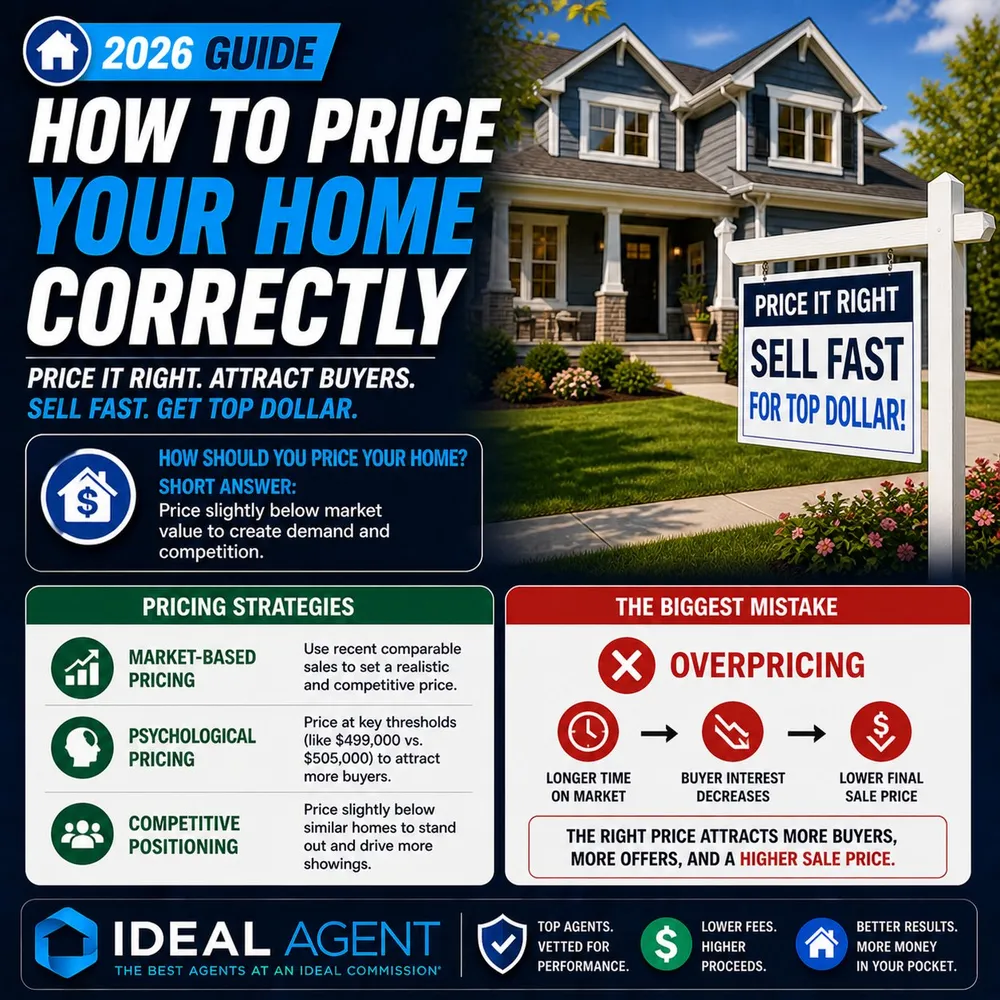
Pricing is the single most important decision you’ll make when selling your home. Get it right and you sell quickly, attract multiple offers, and potentially exceed your asking price. Get it wrong and your home sits, accumulates stigma, and eventually sells for less than a correct price would have produced from day one. Here’s how to get it right.
Short answer: Price slightly below market value to create demand and competition. Buyers gravitate toward homes that feel like value, and competition drives prices up. An overpriced home scares off buyers before they even schedule a showing.
Why Pricing Is the Highest-Leverage Decision in Your Sale
Your list price sets everything in motion. It determines:
- Which buyers see your home — search filters mean overpriced homes get missed by the buyers who could actually afford them
- How many showings you get — buyer interest peaks in the first 7–14 days; a wrong price wastes that window
- Whether you get multiple offers — which is the only reliable way to sell above asking
- Your negotiating leverage — a home with offers has leverage; a home that’s been sitting does not
The goal isn’t to list high and negotiate down. That strategy consistently produces worse outcomes than accurate pricing from day one.
The 3 Core Pricing Strategies
1. Market-Based Pricing
The foundation of any pricing strategy is the comparable market analysis (CMA). Your agent analyzes recently sold homes in your area that are similar to yours in size, condition, location, and features — then adjusts for differences.
The output is a price range your home should realistically sell within given current market conditions.
Key CMA inputs:
- Sold comparables from the last 60–90 days (not older)
- Price per square foot adjusted for your home’s specific features
- Active competition — what buyers are comparing your home against
- Pending sales — leading indicators of where the market is heading
- Expired listings — what price points aren’t working
A professional CMA from an experienced local agent beats Zillow’s Zestimate in accuracy virtually every time. Online estimates lack the granular local knowledge and condition-adjustment precision of a good agent.
2. Psychological Pricing
Buyers search online using price filters with round-number thresholds: $400,000, $450,000, $500,000. Pricing at $499,000 captures everyone searching up to $500,000. Pricing at $505,000 misses them entirely.
Strategic psychological pricing means:
- Pricing just below major thresholds ($499,000 vs. $500,000)
- Avoiding “testing” prices that end in round numbers like $510,000 or $525,000 — these often signal a seller who hasn’t done their homework
The difference between $499,000 and $503,000 may be $4,000 in list price — but the audience difference is enormous.
3. Competitive Positioning
Your home doesn’t exist in isolation. It exists in a competitive marketplace with other listings buyers are simultaneously considering. How you position your home relative to that competition determines how buyers perceive value.
Pricing slightly below the most comparable active listing creates a value perception that drives showings. More showings = more offers. More offers = stronger negotiating position.
This doesn’t mean drastically underpricing. It means pricing with intent — understanding what the market looks like and positioning your home as the obvious best value in its category.
The Biggest Pricing Mistake: Overpricing
Overpricing is the most common and costly mistake sellers make. It feels logical — you can always come down, right? — but the data tells a different story.
The Overpricing Spiral
- Home lists above market value
- Buyers who can afford it ignore it (out of their search range); buyers whose budget fits see it as overpriced
- Showings are low; first-week traffic (the most valuable) is wasted
- Home sits on market; days on market counter climbs
- Price reduction required — but now buyers wonder “what’s wrong with it?”
- Final sale price is lower than a correct list price would have produced
Research consistently shows that homes with price reductions sell for 3%–6% less than comparable homes that were priced correctly from the start. On a $500,000 home, that’s $15,000–$30,000 left on the table.
Why Agents Sometimes Overprice
A known problem in real estate: agents sometimes suggest an inflated list price to win a listing, knowing the seller will be flattered. This is called “buying the listing.” The home then sits, price reductions follow, and the seller is worse off.
The signal: if one agent’s suggested price is significantly higher than all others, ask them to justify it with specific comparable sales. If they can’t, proceed with caution.
How to Evaluate Your Pricing Strategy
Use these benchmarks to assess whether a pricing strategy makes sense:
| Signal | What It Means |
|---|---|
| Multiple offers in week 1 | Possibly underpriced — or a hot market |
| Steady showings, offer within 2–3 weeks | Correctly priced |
| Showings declining after week 2, no offers | Likely overpriced by 3%–5% |
| Few showings from day one | Likely overpriced by 5%+ |
| Zero showings | Significantly overpriced or serious condition issue |
If you’re not getting showings in the first 7–10 days, a pricing conversation with your agent is warranted immediately — not after 30 days.
The Role of Your Agent in Pricing
This is where agent expertise makes the most tangible difference. A skilled listing agent:
- Knows which comps are actually comparable (not just nearby)
- Understands how to adjust for condition, updates, and features
- Reads current market momentum accurately
- Recommends a price that will produce results, not one that flatters you
- Doesn’t “buy the listing” with an inflated number
IDEAL AGENT vets agents specifically on pricing accuracy — measured by list-to-sale price ratios and days on market. An agent who consistently prices homes right sells them faster and for more. That’s the only track record that matters.
Frequently Asked Questions
Should I price my home high to leave room for negotiation?
No. This strategy consistently backfires. Buyers make low or no offers on perceived overpriced homes, and the negotiation room you built in doesn’t get used — instead, you just lose showings and momentum.
How do I know if my home is priced correctly?
The first two weeks tell you almost everything. If you’re getting steady showings and generating offers, pricing is in the right range. If showings are sparse and no offers are coming, reconsider the price.
What is a list-to-sale price ratio?
It’s the percentage of the final sale price relative to the list price. A ratio above 100% means the home sold above asking; below 100% means it sold below. Ask your agent for their personal ratio on recent listings — it’s a direct measure of pricing accuracy.
Should I price at exactly what I want to net?
No. Your net proceeds are your sale price minus costs. Price based on market value, then calculate your net from there. Pricing based on what you “need” to make ignores what the market will actually pay.
How often should I reduce my price if my home isn’t selling?
If you’ve been on market 2–3 weeks with minimal activity, your price likely needs adjustment. A reduction of 2%–4% typically re-engages buyers. Smaller reductions often don’t generate enough attention to matter.
Pricing is too important to get wrong — and it’s exactly where a great agent earns their commission. IDEAL AGENT matches you with a top-performing local agent with a documented track record of pricing homes accurately and selling them fast. Get started free.