How to Get Multiple Offers on Your Home
-
 Research Team
 - 14 May, 2026
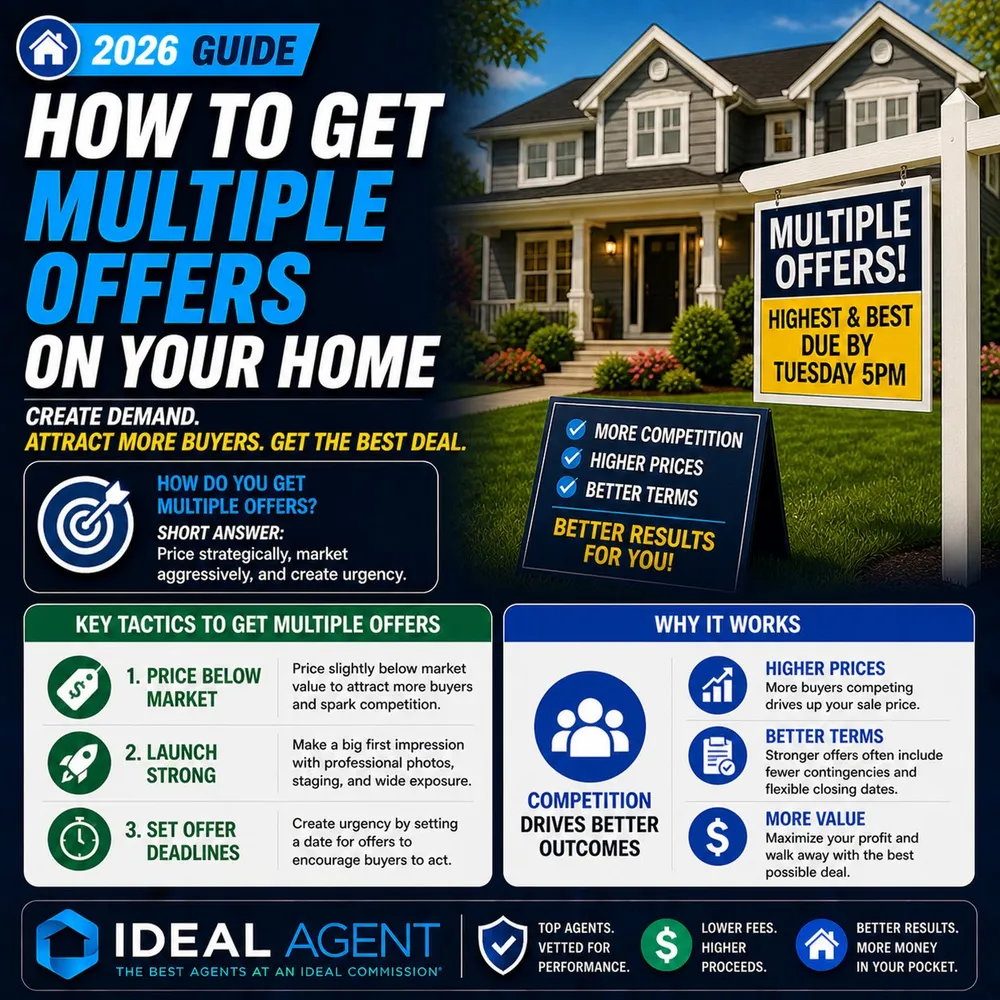
Multiple offers are the best outcome a seller can hope for. When two or more buyers compete for your home, they push prices up, improve terms, and give you the negotiating leverage to demand your best deal. This isn’t luck — it’s strategy. Here’s exactly how it works.
Short answer: To generate multiple offers, price strategically to attract maximum buyer interest, launch with a polished presentation, market aggressively, and set a clear offer deadline that creates urgency. Competition drives higher prices and better terms.
Why Multiple Offers Change Everything
When you receive a single offer, the buyer has all the leverage. They know you have no alternatives. They can negotiate hard, ask for concessions, and take their time.
When you have multiple offers, the dynamic reverses entirely:
- Higher prices — buyers must compete on price, not just negotiate down
- Better terms — competing buyers waive contingencies, offer larger deposits, and accommodate your timeline
- More certainty — you can choose the strongest buyer, not just the only buyer
- Faster closing — motivated buyers in a competitive situation don’t drag their feet
The multiple-offer scenario is the difference between a good sale and a great one.
Tactic #1: Price to Create Demand, Not to Test the Market
The most reliable way to generate multiple offers is to price your home slightly below market value — intentionally. This feels counterintuitive, but the math works:
- More buyers enter the consideration set because the price looks compelling
- More showings happen in the critical first 7–14 days
- More interested buyers means more offers submitted
- Competing offers push the final price above list — often higher than you’d have gotten with an inflated starting price
A home listed at $489,000 in a market where $500,000 is fair value will attract more buyer attention than one listed at $510,000 — and the final sale price of the $489,000 listing often exceeds $500,000 because of competition.
What not to do: List at a price you’re “willing to accept” as a floor, then hope for the best. That approach produces one offer at your minimum, not multiple offers above it.
Tactic #2: Launch Strong — Make Your First Week Count
Your first week on the market is your best week. Buyer attention and agent alerts spike when a new listing hits. The way you launch determines whether that traffic converts into showings and offers.
The Pre-Launch Checklist
Before your listing goes live:
- Professional photography — non-negotiable; the listing photos are your first showing
- Video walkthrough or 3D tour — especially valuable for out-of-area buyers
- Polished listing copy — highlights the home’s best features without overselling
- Clean, staged, and showing-ready — every day of your active listing
- All repairs completed — nothing undermines a showing like visible deferred maintenance
Timing Your Launch
List on a Thursday or Friday to maximize first-weekend showing activity. Homes that go live early in the week miss the highest-traffic weekend window.
Consider a coming soon period of 5–7 days (where your MLS allows it). This builds anticipation among active buyers and creates day-one momentum.
Tactic #3: Market Aggressively Beyond the MLS
MLS entry gets your home in front of buyer’s agents. That’s necessary but not sufficient for generating maximum interest.
A high-performing listing agent should be doing all of the following:
- Syndication — Zillow, Redfin, Realtor.com, and other major platforms
- Social media promotion — targeted ads to buyers in your area and at your price point
- Email outreach to active buyer’s agents in the local market
- Open houses — a well-run open house creates social proof and urgency
- Agent network outreach — direct promotion to agents with active buyer clients
The more buyers who know about your home, the more competition you create. Passive marketing produces passive results.
Tactic #4: Set an Offer Deadline
An offer deadline is the most powerful urgency tool a seller has. By announcing that you’ll review all offers on a specific date and time, you:
- Signal that you expect multiple offers (which becomes self-fulfilling)
- Force buyers to commit rather than “think about it”
- Prevent buyers from submitting low opening bids and waiting to see how you respond
- Concentrate all offers in one window for easy comparison
How to set it: List Thursday. Open house Saturday and Sunday. Offer deadline Monday at 5pm. Review and respond Tuesday.
This 5-day structure is the most effective offer-generation sequence in most markets.
Tactic #5: Create Perfect Showing Conditions
You can have the right price and the right marketing, but if your home doesn’t show well, buyers won’t make offers. Every showing is a sales opportunity.
Showing standards:
- Home must be clean and staged for every showing — not just open houses
- All lights on, blinds open, temperature comfortable
- Pet and odor-free (this affects buyer perception more than sellers realize)
- Personal items minimized so buyers can visualize the space as theirs
- Be out of the home during showings — buyers don’t linger or discuss freely when sellers are present
How to Handle Multiple Offers When They Arrive
Receiving multiple offers is exciting — but it requires a clear strategy to maximize your outcome.
Option 1: Accept the Best Offer
If one offer is clearly superior — best price, best terms, most reliable buyer — accept it. Simple.
Option 2: Counter One Offer
If one offer is very close to your ideal but not quite there, counter that buyer alone. Clean and efficient.
Option 3: Call for Highest and Best
Ask all buyers to submit their “highest and best” offer by a new deadline. This is the most common approach in competitive situations and often results in meaningful price escalation.
Key things to compare beyond price:
- Contingencies (fewer = stronger)
- Earnest money deposit (larger = more committed buyer)
- Closing timeline (does it fit your needs?)
- Loan type (conventional loans appraise more reliably than FHA/VA)
- Cash buyers (no financing risk, often faster close)
Frequently Asked Questions
Does pricing below market always generate multiple offers?
Not always — market conditions matter. In a buyer’s market with high inventory, even strategic pricing may not produce multiple offers. But it will produce more activity than overpricing, and activity leads to offers.
Can I set an offer deadline if I’m not sure I’ll get multiple offers?
Yes. Setting a deadline is a strategic tool, not a guarantee. If you only receive one offer, you can still negotiate or extend the deadline. The downside risk is minimal; the upside is significant.
What if I get multiple offers but none meet my price?
Counter the strongest offer. Or call for highest and best from all parties. You’re not obligated to accept any offer — but be realistic about what the market is telling you.
Should I tell buyers there are other offers?
In most states, you can — and experienced agents often do, to encourage buyers to put their best foot forward. Your agent should handle this communication carefully and ethically.
How long should I review offers before making a decision?
24–48 hours is standard. Taking too long can cause buyers to withdraw or lose enthusiasm. Your agent should help you move efficiently once offers are in hand.
Multiple offers don’t happen by accident — they’re engineered through smart pricing, a strong launch, and aggressive marketing. IDEAL AGENT matches you with top local listing agents who know exactly how to generate buyer competition. Get started free.