How to Choose the Right Real Estate Agent (2026 Guide)
-
 Research Team
 - 02 May, 2026
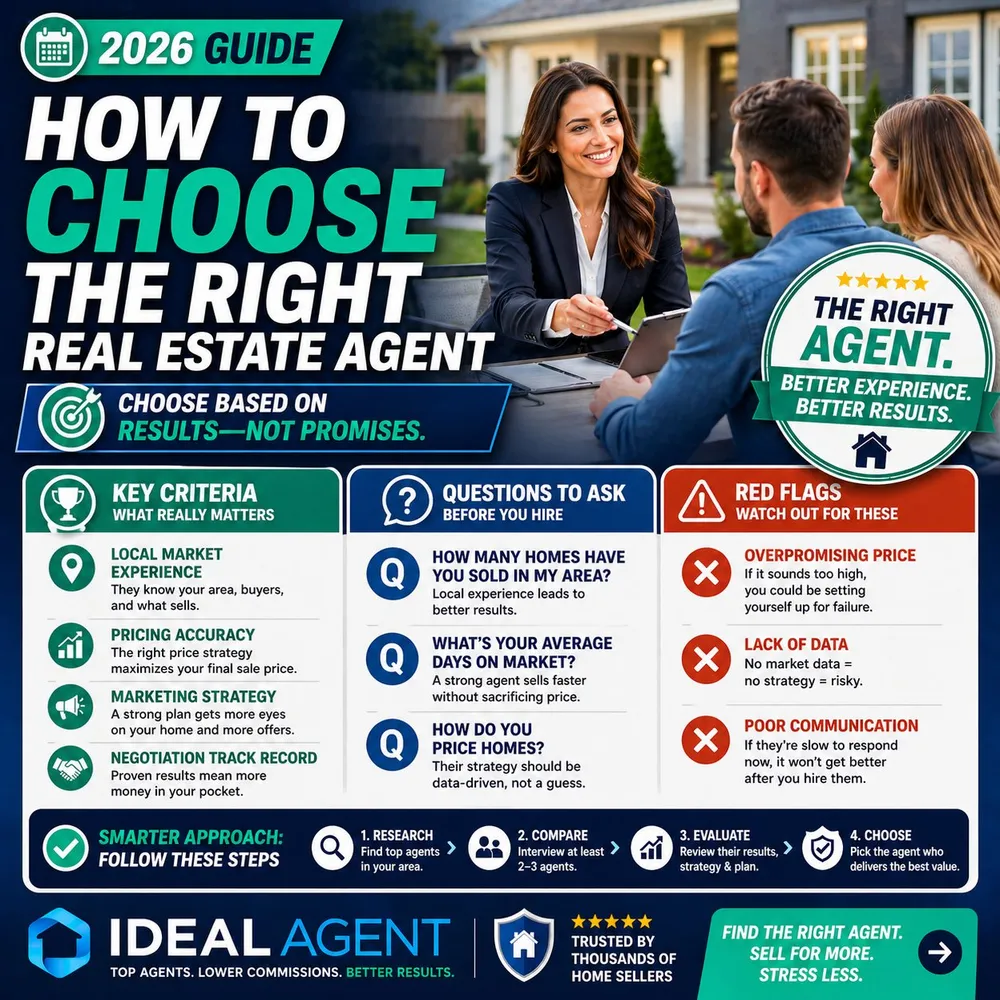
Choosing a real estate agent is one of the most consequential financial decisions in the home selling process. The right agent can net you tens of thousands more. The wrong one costs you time, money, and stress. Most sellers make this decision too quickly, with too little information.
Here’s a step-by-step framework for choosing the right agent — based on data, not gut feeling.
How Do You Choose the Right Real Estate Agent?
Short answer: Choose based on verifiable results — local sales volume, list-to-sale price ratio, and days on market performance — not on personality, promises, or referrals alone. The agent who tells you what you want to hear and the agent who will get you the best outcome are often not the same person.
Step 1: Define What “Right” Means for Your Situation
The best agent for a $250,000 starter home sale is not necessarily the best agent for a $900,000 luxury listing. Before you start interviewing, clarify:
- Your price range — Agents build buyer networks in specific price brackets. An agent who primarily sells $200,000–$350,000 homes may not have the relationships or experience to market a $700,000 listing effectively.
- Your timeline — If you need to close quickly, prioritize agents with documented fast-sale track records. If you have flexibility, a broader pool works.
- Your neighborhood — Zip-code-level local expertise matters more than general experience. An agent who has sold 8 homes on your street knows buyer demand, pricing nuance, and neighborhood objections that no amount of broader experience can replace.
- Your priorities — Maximum price? Fastest close? Most stress-free process? Different agents excel at different things. Know what you’re optimizing for before you start comparing.
Step 2: Generate a List of Candidates
Start with 3–5 potential agents before narrowing down. Sources:
Performance-based matching services. Services like IDEAL AGENT screen agents on local sales volume, list-to-sale ratios, and market expertise — then match you with the top 1% in your area. This is the most reliable starting point.
Local MLS transaction data. In most markets, you can research which agents have sold the most homes in your zip code in the last 12 months. This is public information and the most objective filter available.
Yard signs and neighborhood activity. Agents with multiple active listings and recent sold signs in your neighborhood are demonstrating current local activity — a meaningful signal.
Referrals — with context. Personal referrals are useful, but ask specifically: “Did they represent you as a seller or buyer? What was the final sale price vs. asking? How long did it take?” One data point from a friend is useful context, not a recommendation on its own.
Step 3: Evaluate Each Agent on These 5 Criteria
Criterion 1: Local Market Production
The most important filter. Ask each agent:
- How many homes have you sold in my zip code in the last 12 months?
- What price range do most of your listings fall in?
- Can you show me recent comparable sales you’ve represented?
An agent with 15+ local transactions in the past year has current, real-time market knowledge. An agent with 2–3 has general knowledge.
Criterion 2: Pricing Accuracy
Pricing is the highest-leverage decision in the sale. An agent who consistently prices homes correctly generates faster sales and stronger final prices.
Ask for their list-to-sale price ratio — what percentage of asking price do their sellers actually receive? A ratio of 98–101% is strong. A ratio of 94–96% means their sellers are routinely accepting offers well below asking — whether from overpricing or weak negotiation.
Also watch for the “buying the listing” pattern: an agent who suggests a list price significantly above what the comparable data supports is telling you what you want to hear, not what the data shows. They’ll ask for a price reduction later — after you’ve lost your first-week momentum.
Criterion 3: Marketing Quality
In 2026, your home is found online before it’s toured in person. Marketing quality directly determines how many qualified buyers see your listing — and how motivated they are when they arrive.
Before hiring any agent, ask to see their 3 most recent listings:
- Are the photos professionally shot and edited?
- Is the listing description compelling and specific?
- Did they use a 3D virtual tour or video walkthrough?
- How did the listing perform in terms of views and showing requests?
A great marketing plan includes: professional photography, 3D tour, full MLS listing with complete details, social media promotion, and an email campaign to the agent’s buyer network. A weak plan is “I’ll list it on the MLS.”
Criterion 4: Negotiation Track Record
Ask specifically: “Can you walk me through a recent transaction where your negotiation made a material difference for your seller?” Strong negotiators have stories. Agents who haven’t produced standout results in negotiation often pivot to generic answers about “advocating for my clients.”
Also ask: “How do you handle multiple offers?” and “What’s your strategy for post-inspection negotiations?” The specificity of their answers tells you whether this is theory or practiced skill.
Criterion 5: Communication and Process
You’ll be working closely with this person through a high-stakes transaction. Ask:
- How will you communicate with me, and how often?
- What’s your typical response time to calls and messages?
- How many active listings are you currently managing?
An agent managing 30+ listings simultaneously may not have the bandwidth to give your transaction the attention it deserves — especially during fast-moving moments like offer deadlines and post-inspection negotiations.
Step 4: Compare the Listing Presentations
After initial screening, invite your top 2–3 candidates to present a listing proposal. Evaluate:
The pricing recommendation. Does it come with a detailed CMA showing specific comparable sales? Does the agent walk you through how they weighted each comp? A well-reasoned price recommendation backed by data is very different from a round number delivered with confidence.
The marketing plan. Is it specific or generic? Does it include a timeline, specific platforms, photographer name or portfolio link? Vague marketing plans don’t become specific once you sign.
Their commission and what it covers. Ask each agent exactly what their commission includes. Compare apples to apples — some agents include professional photography, some charge extra. Know the full cost before deciding.
Their availability and communication style. Do they listen to your priorities or lead with their preferences? Are they responsive between your initial call and the presentation? These signals hold during the transaction.
Step 5: Check References and Recent Results
Before signing, ask each final candidate for contact information for 2–3 recent seller clients — specifically sellers of homes similar to yours in your area. Ask those sellers:
- How did the final sale price compare to the list price and your expectations?
- How did the agent handle the inspection and any post-offer negotiations?
- Were they responsive when you needed them?
- Would you hire them again?
Red Flags to Walk Away From
- Overpromising price. If an agent’s suggested list price is significantly higher than what comparables support, they’re buying the listing. This costs sellers time and money.
- Vague answers to performance questions. Strong agents know their numbers. Weak ones don’t.
- Pressure to decide immediately. High-performing agents are confident enough to give you time. Pressure tactics suggest they need your business more than you need them.
- Generic marketing plan. No specific photographer. No 3D tour. No social media plan. “I’ll get it on Zillow” is not a strategy.
- Poor communication during the evaluation process. If they’re slow to respond when trying to earn your business, they’ll be slower once you’ve signed.
Frequently Asked Questions
How many agents should I interview?
At minimum, two. Ideally three. Seeing multiple agents side by side gives you context for evaluating their pricing recommendations, marketing plans, and commission structures. Sellers who interview only one agent have no frame of reference and routinely overpay or hire suboptimally.
Should I hire a friend or family member who is a real estate agent?
Only if they meet the objective performance criteria above. Personal relationships complicate business decisions in both directions — you may feel unable to negotiate their commission or push back on their recommendations, and they may feel uncomfortable delivering bad news about your home’s value or condition. If they’re genuinely a top performer in your market, great. If they’re not, the relationship can cost you money and strain the friendship.
Does it matter if my agent is part of a team?
Teams can be highly effective — experienced agents supported by transaction coordinators, marketing specialists, and buyer networks often outperform solo agents at the same volume. What matters is who will be your primary contact and who will show up at critical moments: the offer deadline, the inspection negotiation, the appraisal. Get specifics on who handles what before signing.
Is the highest-commission agent always the best?
No — and neither is the lowest. Commission rate and agent quality are independent variables. The goal is the highest-quality agent at the most competitive rate. IDEAL AGENT connects sellers with top 1% agents at a pre-negotiated 2% listing commission — eliminating the trade-off between quality and cost.
Ready to skip the guesswork? IDEAL AGENT matches you with a top 1% vetted local agent at a 2% listing commission. Free, fast, and no obligation.