How to Choose the Best Listing Agent in 2026
-
 Research Team
 - 10 May, 2026
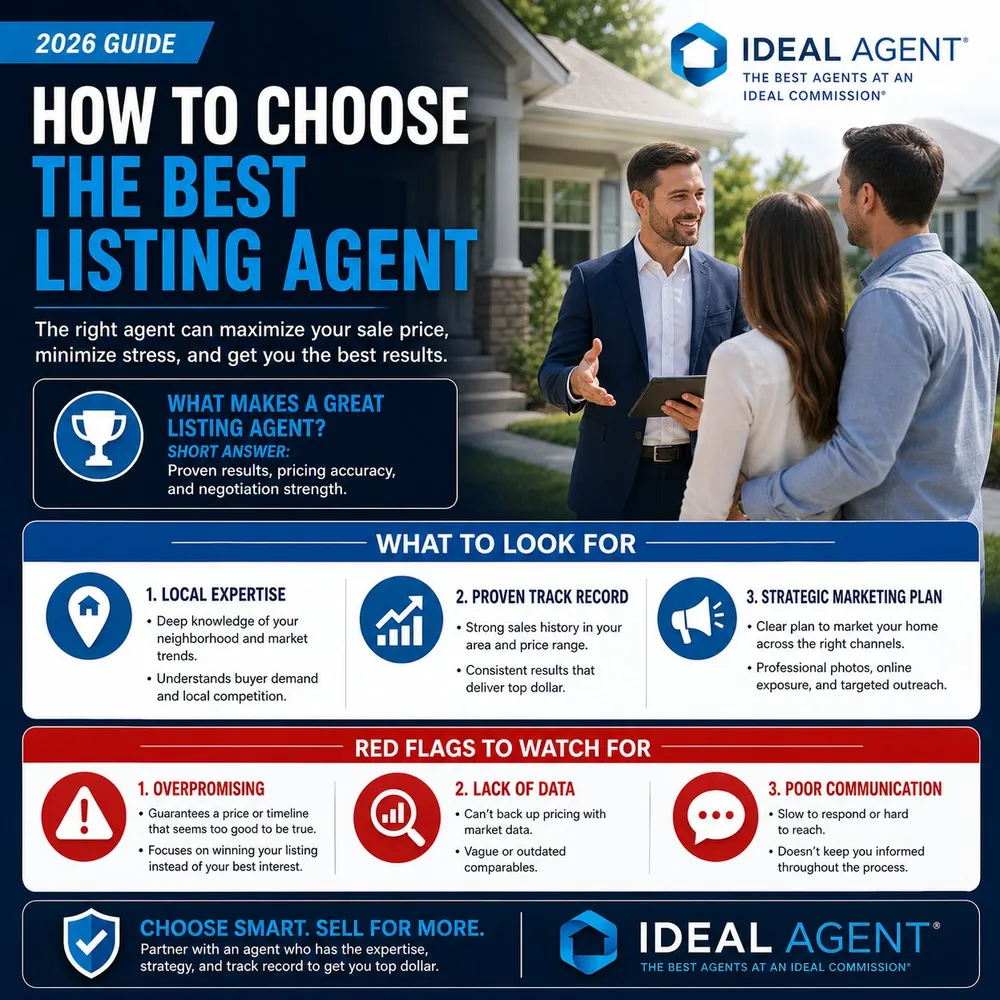
Your listing agent is the most consequential hiring decision in your home sale. The right agent adds tens of thousands of dollars in outcomes through accurate pricing, aggressive marketing, and skilled negotiation. The wrong one costs you time, money, and stress — often without you knowing exactly why things went sideways. Here’s how to choose correctly.
Short answer: The best listing agent has proven local results, pricing accuracy you can verify, a real marketing plan, and strong communication. Great agents earn their commission many times over. Mediocre agents just collect it.
What a Listing Agent Actually Does
Before you can evaluate an agent, understand what you’re paying for. A full-service listing agent should:
- Conduct a thorough comparative market analysis and recommend a data-backed list price
- Advise on pre-listing preparation and what improvements to make (or skip)
- Coordinate professional photography, staging guidance, and listing copy
- List on the MLS and syndicate to all major buyer platforms
- Execute an active marketing plan — not just wait for showings
- Schedule and coordinate showings
- Present and analyze all offers with you
- Negotiate on your behalf through the accepted offer
- Manage the transaction from contract to close — inspections, appraisals, title, lender timelines
- Problem-solve the inevitable issues that arise between contract and closing
This is a substantial amount of work. The agents who do all of it well consistently produce better outcomes for sellers.
What to Look For in a Listing Agent
1. Local Market Expertise
Local expertise is irreplaceable. An agent who knows your specific neighborhood, the comparable sales, the buyer demographic, and the local inventory trends will price and market your home more effectively than a generalist.
Ask:
- How many homes have you sold in this zip code/neighborhood in the past 12 months?
- What’s the current inventory level in my price range?
- Which specific comps are you using to support this price?
2. A Proven Track Record — in Numbers
Past performance is the best predictor of future results. The data to ask for:
- List-to-sale price ratio — what percentage of list price do their homes sell for? Above 100% is exceptional; consistently below 97% is a concern
- Average days on market — how long do their listings typically sit? Compare to the local market average
- Number of recent transactions — a high-volume agent has current market knowledge; very low volume is a red flag at any experience level
- Price range experience — does the agent regularly sell homes in your price bracket?
3. A Real Marketing Plan
Ask every agent: “What is your specific marketing plan for my home?”
The answer should include more than “MLS listing and open houses.” Strong answers include:
- Professional photography and/or video walkthrough
- Listing syndication to all major buyer platforms
- Social media advertising targeted to buyers in your area and price range
- Outreach to active buyer’s agents in the local market
- Email marketing to the agent’s buyer database
- Strategic open house schedule
- Coming soon promotion where permitted
If the plan sounds vague or the agent can’t articulate specifics, their marketing will be vague too.
4. Communication Style and Responsiveness
You’ll be working closely with this person through one of the most significant financial transactions of your life. Communication problems become expensive problems — missed deadlines, confusion on offer details, and poor buyer’s agent relationships all stem from poor communication.
- How quickly did they respond to your initial inquiry?
- Do they communicate by phone, email, and text? Can they adapt to your preference?
- Will you be working directly with them, or with an assistant/team member?
- How often will they proactively update you during the listing period?
5. Negotiation Approach
Ask each agent: “Tell me about a difficult negotiation you handled recently. How did it go?”
Listen for: strategic thinking, advocacy for the seller, awareness of leverage, and composure under pressure. The best negotiators understand that every deal point matters and that the offer price is just the beginning.
Questions to Ask Every Listing Agent
Before signing a listing agreement, ask every candidate these questions:
| Question | What You’re Evaluating |
|---|---|
| What is your list-to-sale price ratio over the last 12 months? | Pricing accuracy and negotiation strength |
| What’s your average days on market vs. local average? | Marketing and pricing effectiveness |
| How many homes have you sold in this area this year? | Local expertise and current market activity |
| What specifically is your marketing plan for my home? | Marketing capability and effort |
| How do you handle multiple offers? | Negotiation experience |
| Who handles showings and communication day-to-day? | Whether you’ll be working with them or an assistant |
| What’s your commission, and what does it include? | Value alignment |
Red Flags to Watch For
Not every red flag is obvious. Here are the ones that matter:
Overpromising on Price
An agent who suggests a list price significantly higher than all others may be “buying the listing” — flattering you with a high number to win your business, with the intention of reducing later. This consistently produces worse outcomes. Ask for specific comps to justify any suggested price.
Vague or Thin Marketing Plan
“I’ll put it on the MLS and hold open houses” is not a marketing plan. If an agent can’t articulate a specific promotional strategy, expect minimal promotion.
Slow Initial Response
If it took 48+ hours to hear back from an agent when you were a potential client, how long will it take when you’re under contract and need a quick answer?
Limited Local Transaction History
An agent who hasn’t sold homes recently in your area lacks current market data. Real estate moves quickly; stale experience is a liability.
Pressure to Sign Immediately
Quality agents are confident in their value proposition. Pressure to sign a listing agreement at the first meeting — before you’ve interviewed others — is a sign of insecurity, not strength.
How Many Agents Should You Interview?
Interview at least two, preferably three. One interview gives you no comparison point. Two or three interviews let you contrast approaches, pricing rationale, and marketing plans — and almost always produce a better hire.
Use the first interview to ask questions. Use subsequent ones to refine your standards.
What About Commission?
Commission is negotiable. Top agents know their value and don’t always discount — but the market has shifted and many experienced agents have flexibility, especially at higher price points.
IDEAL AGENT takes a different approach: we pre-negotiate lower commission rates directly with vetted, high-performing local agents before matching them with sellers. You don’t have to negotiate awkwardly or trade quality for savings — our agents deliver full-service representation at a reduced rate.
Frequently Asked Questions
How do I find good listing agents to interview?
Ask for referrals from people who have recently sold in your area. Check online reviews (Google, Zillow, Realtor.com). Or use a service like IDEAL AGENT that pre-vets agents on performance data before presenting them to sellers.
Should I hire a friend or family member who’s an agent?
Only if they can demonstrate the track record and local expertise the role requires. Mixing personal relationships with a major financial transaction creates complexity — hold them to the same standards as any other candidate.
Is a team or a solo agent better?
Both can work well. Teams offer more coverage and resources; solo agents offer more direct attention. Ask specifically who will be your primary contact and who handles showings, offers, and closing — regardless of team structure.
What’s a fair listing agent commission?
Listing agent commission typically runs 2.5%–3% of the sale price, separate from any buyer’s agent commission. IDEAL AGENT pre-negotiates this rate down with qualified agents while maintaining full service.
How long is a typical listing agreement?
Most listing agreements run 3–6 months. Be cautious of very long agreements with agents you haven’t worked with before. 60–90 days is a reasonable starting term, with the option to extend.
Choosing the right listing agent is the highest-leverage decision in your home sale. IDEAL AGENT makes that decision easier by matching you with pre-vetted, top-performing local agents — at a lower commission than you’d typically negotiate yourself. Start your match for free.