How to Choose a Buyer's Agent (2026 Guide)
-
 Research Team
 - 05 May, 2026
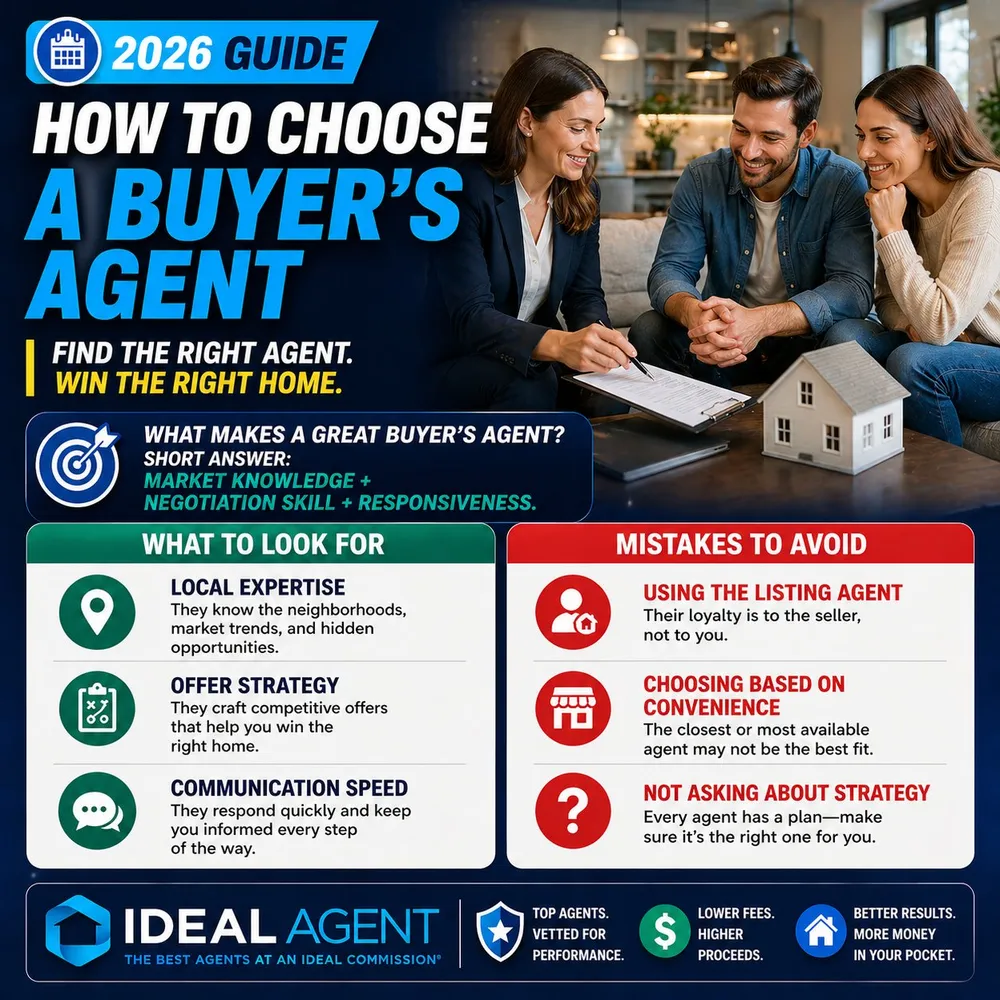
Choosing a buyer’s agent is one of the most important decisions in the home buying process — and one of the most underestimated. Most buyers work with whoever responds first, or whoever a friend used. In 2026, with the market more competitive and commission structures more transparent than ever, that approach costs buyers real money and real opportunities.
Here’s how to choose a buyer’s agent who will actually get you into the right home at the right price.
What Makes a Great Buyer’s Agent?
Short answer: Local market expertise, a proven offer strategy, strong negotiation skills, and genuine responsiveness. A great buyer’s agent knows the market well enough to identify value, moves fast enough to compete, and negotiates skillfully enough to protect your interests from offer through closing.
What Has Changed for Buyers in 2026
The 2024 NAR settlement fundamentally changed how buyer’s agents are compensated. The key changes:
You must sign a Buyer Representation Agreement before touring homes. This agreement discloses your agent’s compensation, the term of the relationship, and the conditions under which you may owe them a fee. Read it carefully before signing.
Buyer agent compensation is separately negotiated. Sellers are no longer required to offer buyer agent compensation through the MLS. Many still do (typically 2–2.5%), but it’s now a separate, negotiated term rather than an automatic feature. Your agreement with your agent determines who pays and how much.
You may owe your agent directly in some cases. If a seller offers less compensation than your agent charges, you may be responsible for the difference. Know this before you start shopping in specific price ranges and markets.
These changes make choosing the right agent more important than ever — because you need to understand exactly what you’re agreeing to before you sign.
The 5 Qualities That Separate Top Buyer’s Agents
1. Genuine Local Market Expertise
This is the most important and most commonly oversold quality. “I know this market” is something every agent says. The difference between knowing a market and deeply knowing a specific market shows up in specifics:
- Can they name streets or pockets within neighborhoods that are undervalued vs. overpriced?
- Do they know which sellers have been on market too long and may be motivated?
- Can they tell you what comparable homes have actually sold for in the last 60 days — not just list prices?
- Do they know about off-market opportunities that never hit Zillow?
Ask agents specific questions about your target neighborhoods and listen for depth of knowledge, not generic confidence.
2. Offer Strategy and Competitive Awareness
In competitive markets, getting the right home requires more than writing an offer at asking price. A strong buyer’s agent knows:
- How to structure offers that are competitive on total terms — not just price
- When escalation clauses make sense and how to use them strategically
- Which contingencies to include and which can be waived safely given the situation
- How to make a clean, attractive offer that sellers prefer over technically higher offers with complicated terms
- How to move fast — because in competitive markets, a day of delay can cost you the home
Ask specifically: “How do you help buyers win in competitive situations?” The answer tells you whether this is theory or practiced skill.
3. Negotiation That Works Both Ways
Strong buyer’s agent negotiation matters at two distinct stages: the offer and after the inspection.
Offer negotiation: In a competitive market, your agent’s ability to craft a compelling offer that stands out matters more than their ability to negotiate price down. Know what kind of market you’re buying in before assuming negotiation will go your way.
Post-inspection negotiation: The home inspection almost always reveals something. A skilled agent knows what’s material vs. what’s cosmetic, how to request repairs or credits strategically, and when to hold firm vs. when to take a credit and move on. A weak agent either asks for too much (killing the deal) or accepts too little (costing you money).
4. Communication Speed and Reliability
Real estate moves fast. In competitive markets, the difference between getting a showing and missing it, between submitting an offer and being too late, can be hours. Your agent’s communication speed is not a minor convenience — it’s a competitive advantage.
What to evaluate:
- How quickly do they respond to your initial inquiry? (This is the best data point you’ll have before hiring)
- Do they proactively send you listings that match your criteria, or do you have to find everything yourself?
- Do they communicate via your preferred channel, or only theirs?
- What happens when they’re unavailable? Who covers?
Test it: Reach out to an agent with a specific question and note how long it takes to get a substantive response. The speed and quality of that response is a reliable preview of what working with them will be like.
5. Buyer-Side Transaction Experience
Not all agents who represent buyers do so as their primary business. Some listing agents take buyer clients opportunistically. The skill sets are meaningfully different.
An agent who primarily represents buyers:
- Has deeper knowledge of the buying process from the buyer’s perspective
- Has stronger relationships with buyer-side vendors (lenders, inspectors, attorneys)
- Is more attuned to buyer-side risks and how to manage them
- Is more practiced at the offer and post-inspection negotiation dynamics that protect buyers
Ask any agent what percentage of their business is buyer representation vs. listings. Agents who primarily represent sellers may not have the same depth on the buyer side.
Questions to Ask Before Hiring a Buyer’s Agent
- How many buyers have you represented in my target neighborhoods in the last 12 months?
- What is your strategy for helping buyers win in competitive situations?
- How do you typically handle the post-inspection negotiation?
- What is your average response time when a new listing hits that matches my criteria?
- What is your compensation, and what happens if the seller doesn’t offer it?
- How long is the Buyer Representation Agreement, and can I cancel if it’s not working?
- Who covers for you when you’re unavailable?
Mistakes to Avoid When Choosing a Buyer’s Agent
Using the listing agent. The listing agent represents the seller — their fiduciary duty is to the seller’s interests, not yours. In many states, an agent can legally represent both parties (“dual agency”), but this fundamentally compromises the representation quality each party receives. Always use your own agent.
Choosing based on convenience. Working with whoever responds first, is available immediately, or is the most geographically convenient doesn’t optimize for the quality that actually matters in a competitive market.
Not reading the Buyer Representation Agreement. This is now a required document. Read every line — particularly the compensation terms, the agreement duration, and the cancellation provisions. A long-term exclusive agreement with no cancellation terms locks you in to an agent regardless of how the relationship develops.
Assuming your agent is working full-time for you. Ask how many active buyer clients your agent is currently working with. An agent with 15 active buyers is giving each one a fraction of the attention an agent with 4 active buyers provides. High-volume buyer’s agents are not always better — attention and availability matter.
Not asking about the market. Your best filter in an agent interview is asking specific, local questions about the market. “What’s happening with inventory in [specific neighborhood] right now?” reveals whether they genuinely know the market or are speaking from general real estate knowledge.
How Buyer’s Agent Compensation Works in 2026
Since the 2024 NAR settlement:
- You sign a Buyer Representation Agreement disclosing the agent’s compensation before touring homes
- Sellers often (but not always) offer buyer agent compensation — typically 2–2.5%
- If the seller’s offer matches or exceeds your agent’s fee, you pay nothing out of pocket
- If there’s a gap, you may owe the difference
- In some markets and with some agents, buyers may negotiate a commission rebate
What to discuss upfront with any agent:
- What is your fee?
- What happens if the seller offers less than your fee?
- Do you offer rebates?
Getting clear answers to these questions before signing anything protects you from surprises at closing.
Frequently Asked Questions
Do I need a buyer’s agent to buy a house?
No — you can purchase without one. But navigating offer strategy, negotiation, inspection, and closing without representation in a market where the seller has an experienced listing agent working against your interests is a significant disadvantage. Most buyers benefit materially from strong buyer’s agent representation.
How do I find a good buyer’s agent?
Ask specifically about their local transaction volume in your target neighborhoods, their offer strategy in competitive situations, and their communication speed. Interview at least two agents before deciding. A referral service that screens agents on performance metrics can narrow the field efficiently.
Is it better to use an agent from a big brand vs. an independent agent?
Brand affiliation doesn’t predict performance. Local transaction volume, offer win rates in competitive situations, and client communication quality are far more predictive than the logo on the business card. Focus on individual agent metrics, not brokerage brand.
Can I use the same agent to buy and sell?
Yes — and there can be advantages to using one agent who understands both sides of your situation and can coordinate timelines. Just make sure the agent has strong credentials on both the listing and buyer sides. Some agents excel at one and are adequate at the other.
Buying a home and want to work with a top-performing local agent who knows your target market? IDEAL AGENT connects buyers with top 1% local agents. Get matched today — free, no obligation.