Online Home Value Estimators Compared: Which Is Most Accurate?
-
 Research Team
 - 08 Aug, 2026
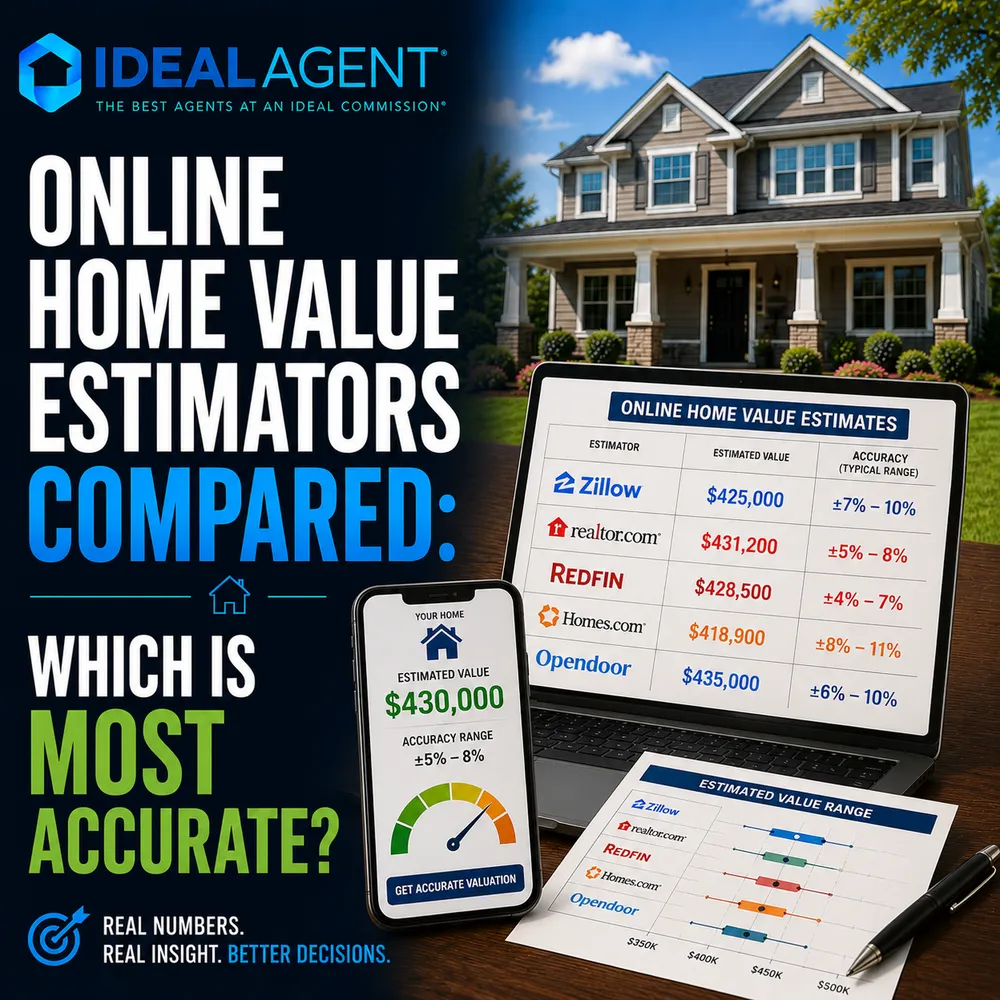
Type your address into three different home value estimators and you’ll likely get three different numbers — sometimes tens of thousands of dollars apart. Understanding why helps you use these tools for what they’re actually good at, instead of treating any single number as gospel.
Short answer: Online home value estimators (Zillow’s Zestimate, Redfin’s Estimate, Realtor.com’s estimate, and others) all use automated valuation models built on public records and recent sales, but each uses different data sources, algorithms, and update frequencies — which is why they rarely agree exactly. None of them replace a professional comparative market analysis or a formal appraisal for setting an actual listing price.
How Do Online Home Value Estimators Actually Work?
These tools are built on automated valuation models (AVMs) — software that analyzes public property records, tax assessment data, recent comparable sales, and in some cases user-submitted home details to generate a value estimate without any human inspection of the property. The core approach is similar across platforms, but the specific data sources, weighting, and update frequency differ enough to produce meaningfully different numbers for the same home.
How Do the Major Estimators Compare?
| Tool | Data sources | Typical strengths | Typical limitations |
|---|---|---|---|
| Zillow Zestimate | Public records, tax data, comparable sales, user-submitted facts | Widely used, frequently updated, transparent published error rates | Can lag on unrecorded improvements; wider error range for off-market or unique homes |
| Redfin Estimate | MLS data, public records, comparable sales | Often cited as competitive accuracy in markets with strong MLS data access | Less consistent in markets with limited MLS coverage |
| Realtor.com Estimate | Public records, MLS data, comparable sales | Integrated with active listing data | Accuracy varies significantly by market coverage |
| Bank/lender AVMs | Proprietary data, often used for refinance pre-screening | Used internally by lenders for quick reference | Not typically designed for consumer-facing pricing decisions |
Because each tool weighs its inputs differently, it’s common to see estimates for the same home vary by 5–15% or more between platforms, particularly in markets with fewer recent comparable sales.
Why Do Different Estimators Give Different Numbers for the Same House?
Several factors drive these discrepancies. Each platform pulls from different data sources — some have stronger direct access to MLS data than others, which affects how current and complete their comparable sales information is. Update frequency varies, so one tool might reflect a very recent nearby sale while another hasn’t incorporated it yet. Algorithms themselves differ in how they weight factors like square footage, lot size, and renovation status. And user-submitted data (where platforms allow homeowners to update home facts) is inconsistently maintained, meaning some homes have more accurate underlying data feeding their estimate than others.
Which Estimator Is Actually the Most Accurate?
There’s no single universal answer — accuracy varies by market, by property type, and by how much reliable comparable sales data exists in your specific area. Some tools perform better in dense urban markets with lots of recent transactions; others perform relatively better in markets they have stronger direct data partnerships in. Rather than picking one tool and trusting it exclusively, the more useful approach is checking two or three estimators to see the range they produce, then treating that range as a rough starting point — not a number to price around.
What Should You Actually Do With These Numbers?
Use online estimators as a general sense check, not a pricing decision. If several tools cluster in a similar range, that can be a reasonable rough indicator. If they vary widely, that’s a signal your home may have unique characteristics an algorithm can’t properly account for — which makes professional input even more valuable, not less.
Why Doesn’t Any Automated Tool Replace a Professional Pricing Analysis?
None of these tools can walk through your home, notice a fully renovated kitchen that isn’t reflected in public records, account for how your specific layout shows to buyers, or factor in real-time knowledge of what’s currently happening in your specific micro-market — which streets are in highest demand, which comparable sales are truly comparable versus superficially similar, and what buyers are actually responding to right now. A comparative market analysis from an agent actively working your area incorporates all of this in a way no algorithm currently can.
How Should You Use These Tools Before Listing?
Check two or three reputable estimators to get a general sense of your home’s rough value range. Don’t be surprised if the numbers vary meaningfully — that’s normal, not a sign something’s broken. Use that range as a starting conversation point with a real estate agent, not as your actual listing price. And update your home facts on platforms that allow it, since more accurate underlying data generally improves estimate quality, even if it doesn’t eliminate the inherent limitations of an automated model.
IDEAL AGENT matches sellers with a top 1% local agent who builds your real listing price from verified comparable sales and current market conditions — not competing algorithms guessing at different numbers. That agent lists your home for a firm 2% commission, well below the 2.5–3% many sellers pay with a traditional agent, and the recommended buyer’s agent commission is 2%–2.5%. If a buyer comes directly through that agent’s marketing of your home, your total commission is capped at 2% combined for both sides — accurate, professional pricing without the traditional commission cost.
Frequently Asked Questions
Why is my Redfin Estimate different from my Zestimate?
Each platform uses different data sources, algorithms, and update timing, so discrepancies between the two are common and don’t necessarily mean either one is “wrong” — both carry their own margin of error.
Should I average multiple estimators to get a more accurate number?
Averaging can give a rough sense of the range, but it doesn’t correct for the underlying limitations shared by all automated tools — none of them account for your home’s actual condition or current buyer demand the way a professional analysis does.
Do these estimators account for renovations I’ve made?
Only if that information has made it into public records or been manually updated on the platform, which often lags behind actual work done to a home — don’t assume recent updates are reflected accurately.
Are online estimators more accurate in some markets than others?
Yes — accuracy generally improves in markets with more frequent transactions and stronger data coverage, and tends to be less reliable in rural areas or markets with fewer recent comparable sales.
Can I use an online estimate to challenge my property tax assessment?
Generally not effectively — property tax assessments follow specific local assessment methodologies that differ from consumer-facing home value estimators, and most jurisdictions won’t accept an online estimate as evidence in an appeal.
Do lenders use these same estimators for mortgage decisions?
Not typically for final loan decisions — lenders generally rely on a formal appraisal from a licensed appraiser, though some may use proprietary AVMs for preliminary screening purposes like refinance eligibility.
How much should I trust an online estimate when pricing my home?
Treat it as a rough starting reference only — the final listing price should come from a professional comparative market analysis that accounts for your home’s specific condition and current local market activity.
Skip the guessing game between competing algorithms and get a real number from someone who actually knows your market. Get matched with a top 1% local agent who prices your home accurately and lists for 2% commission.