Net Proceeds Calculator: What You'll Actually Walk Away With
-
 Research Team
 - 01 Aug, 2026
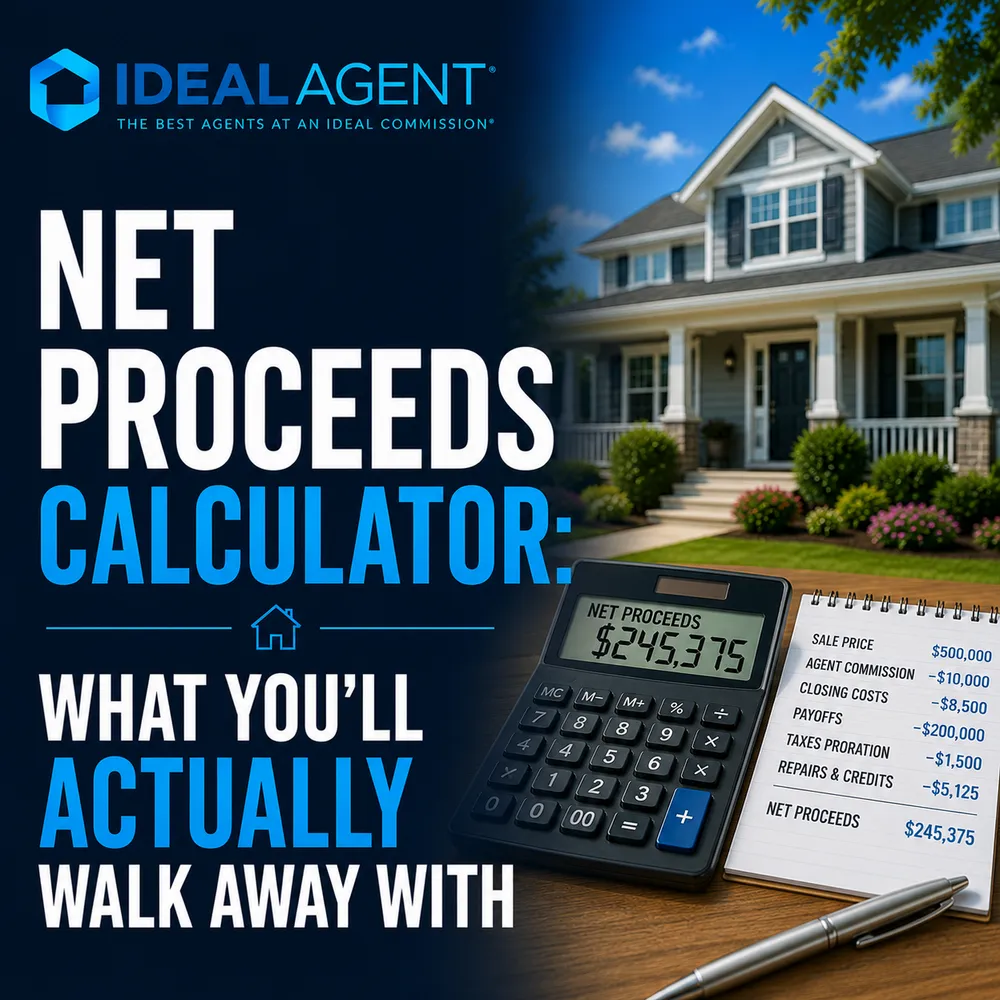
Your sale price is not your payday. Between commission, closing costs, mortgage payoff, and prorated expenses, the number that actually lands in your bank account is often 8–10% lower than what your home sells for — and most sellers don’t calculate it until closing week.
Short answer: Net proceeds = sale price − mortgage payoff − real estate commission − closing costs and fees − prorated taxes/HOA dues − any agreed repairs or credits. Running this calculation before you list, not after you accept an offer, is the only way to know what you’re actually working with.
What Is the Full Net Proceeds Formula?
| Line item | Typical range |
|---|---|
| Sale price | Your accepted offer amount |
| − Mortgage payoff | Remaining loan balance, plus any prepayment penalty |
| − Real estate commission | 2%–6% of sale price, depending on your agent arrangement |
| − Title & closing fees | Roughly 1%–2% of sale price |
| − Transfer taxes | Varies significantly by state and county |
| − Prorated property taxes/HOA dues | Your portion up to closing date |
| − Negotiated repairs or credits | Whatever was agreed after inspection |
| = Net proceeds | What actually hits your account |
What Does a Real Net Proceeds Example Look Like?
Take a home selling for $450,000 with a $220,000 remaining mortgage balance:
| Item | Amount |
|---|---|
| Sale price | $450,000 |
| Mortgage payoff | −$220,000 |
| Commission (traditional, 5.5% total) | −$24,750 |
| Closing costs & title fees (~1.5%) | −$6,750 |
| Transfer taxes (varies by state) | −$2,000 |
| Prorated taxes/HOA | −$1,200 |
| Negotiated repair credit | −$2,000 |
| Net proceeds | $193,300 |
Now run the same sale with a 2% total commission instead of the traditional 5.5%:
| Item | Amount |
|---|---|
| Sale price | $450,000 |
| Mortgage payoff | −$220,000 |
| Commission (2% total) | −$9,000 |
| Closing costs & title fees (~1.5%) | −$6,750 |
| Transfer taxes | −$2,000 |
| Prorated taxes/HOA | −$1,200 |
| Negotiated repair credit | −$2,000 |
| Net proceeds | $209,050 |
Same sale price. Same mortgage. Same closing costs. The only variable that changed is commission structure — and it’s a $15,750 difference in what actually lands in the seller’s account.
Why Do Sellers Underestimate Their Own Costs?
Most online home value estimates only show the sale price — not what it costs to get there. Sellers frequently forget to account for their remaining mortgage balance, especially if they’ve refinanced and aren’t sure of the current payoff amount, prepayment penalties on certain loan types, prorated property taxes and HOA dues that vary based on closing date, and repair credits negotiated after the home inspection, which often aren’t decided until well after the home is listed.
How Do You Build a More Accurate Estimate Before You List?
Request a payoff quote from your mortgage servicer — this is more accurate than your last statement balance. Get a written commission agreement before you sign a listing agreement, including what happens if the buyer’s agent commission changes. Ask your agent for a seller net sheet based on comparable recent closings in your area, not a generic percentage estimate. And budget a repair credit contingency — even well-maintained homes often see $1,000–$5,000 in post-inspection negotiation.
What’s the Difference Between Net Proceeds and Taxable Profit?
This is a common point of confusion. Net proceeds is the cash you receive at closing after paying off your mortgage and covering selling costs. Taxable profit (for capital gains purposes) is calculated separately, based on your cost basis and any applicable exclusion — you can have healthy net proceeds and still owe little or no capital gains tax, or vice versa, since a large mortgage payoff reduces your net proceeds without affecting your taxable gain at all. Keeping these two numbers separate in your head avoids a lot of confusion when you’re estimating what selling will actually mean for you financially.
Which Line Item Can You Actually Control?
Your mortgage payoff, transfer taxes, and prorated bills are largely fixed by your loan and your local jurisdiction. Commission is the one major line item you have real control over — and it’s often the single largest cost on the entire closing statement.
This is the core of what IDEAL AGENT is built around: matching sellers with a top 1% local agent at a firm 2% listing commission, instead of the 2.5–3% traditional rate. The recommended buyer’s agent commission is 2%–2.5% — and if a buyer comes directly through your agent’s marketing of the home, you pay just 2% total commission combined for both sides. On a typical sale, that difference alone can be worth tens of thousands of dollars in additional net proceeds — without sacrificing full-service representation or negotiation strength.
Frequently Asked Questions
Is net proceeds the same as profit?
No. Net proceeds is the cash you receive at closing after paying off your mortgage and covering selling costs. Profit (for tax purposes) is calculated separately, based on your cost basis and any applicable exclusion — you can have healthy net proceeds and still owe little or no capital gains tax, or vice versa.
What’s a seller net sheet?
A seller net sheet is an itemized estimate, usually prepared by your agent or title company, showing your expected proceeds based on your specific sale price, payoff, and closing costs. Ask for one before you sign a listing agreement.
Does a lower commission always mean lower service quality?
Not necessarily — commission rate and agent performance aren’t the same thing. IDEAL AGENT’s model matches sellers with top-performing agents specifically because they’re vetted for results, not because they’re the cheapest option available; the 2% rate is pre-negotiated on the seller’s behalf, not a discount tied to reduced service.
How accurate is an online net proceeds calculator without an agent?
Online calculators can give a rough estimate, but they typically use average commission and closing cost assumptions rather than your specific mortgage payoff, local transfer tax rates, or negotiated terms — a net sheet from your actual agent will be more accurate.
When should I ask for a net proceeds estimate?
Before you sign a listing agreement, and again after you accept an offer, since your final numbers should be updated based on your actual sale price and negotiated terms.
Can my net proceeds be negative?
Yes, in situations sometimes called being “underwater” — if your mortgage balance plus selling costs exceed your sale price, you’d need to bring money to closing rather than receive proceeds. This is uncommon but worth checking early if your home hasn’t appreciated much or you have a high remaining loan balance.
Does a HELOC or second mortgage affect my net proceeds?
Yes — any additional liens on the property, including home equity lines of credit or second mortgages, must also be paid off at closing and should be included in your net proceeds calculation alongside your primary mortgage.
Before you list, know the real number — not just the sale price. Get matched with a top 1% local agent who lists for 2% commission and builds you an accurate net proceeds estimate from day one.